A practical sourcing guide for engineers, contractors, and procurement teams
When specifying threaded pipe fittings, few decisions are more overlooked or more consequential than choosing the right type of pipe nipple. Select the wrong one, and you face installation headaches, premature leaks, or costly rework on-site. Get it right, and your system goes together cleanly, holds pressure, and stays that way for years.
This guide breaks down the two main types of TOE and TBE pipe nipple – explains what the unthreaded center section does (and why its length matters), and walks you through how experienced procurement teams match the right nipple to the right application.
What Is a Pipe Nipple?
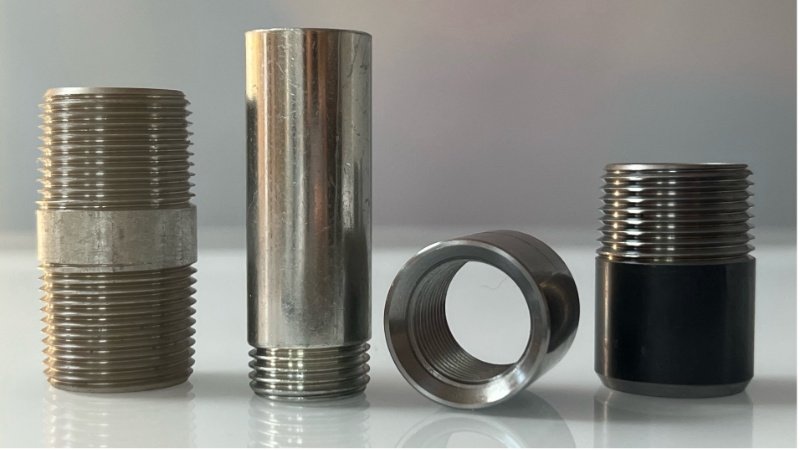
A pipe nipple is a short length of pipe with male (external) threads used to connect two fittings, valves, or equipment. It acts as an extender or bridge within a piping system — bridging gaps, offsetting connections, or allowing access for maintenance.
Pipe nipples are available in a wide range of materials to suit different media and environments:
- Galvanized steel — water supply, fire protection, general plumbing
- Blacksteel — gas lines, industrial systems, steam
- Stainless steel (304/316) — corrosive environments, food & beverage, chemical processing
- Brass — low-pressure water, gas, instrumentation
Thread standards include NPT (North American), BSPT / BSPP (British/European), and ISO 7-1, making nipples compatible with the global supply chain.
TOE vs. TBE Pipe Nipples
TBE Pipe Nipple
A TBE pipe nipple has male threads on both ends with a center section that may or may not be threaded, depending on the subtype.
Advantages:
- Most versatile — connects two female-threaded fittings, valves, or equipment ports directly
- Compact, close nipples eliminate dead space in tight assemblies
- Easily combined with elbows, tees, and couplings to build complex manifolds
- Faster installation in repetitive layouts (consistent length, both ends ready to thread)
Typical applications: Fire sprinkler drop nipples, HVAC risers, industrial instrument connections, pump manifolds, irrigation headers
TOE Pipe Nipple
A TOE pipe nipple has male threads on one end only.
Advantages:
- Ideal when one end connects to a threaded fitting, and the other is welded, flanged, or clamped into a vessel or equipment
- Reduces the number of joints in a system, minimizing potential leak points
- Better suited for transitions between threaded and non-threaded piping sections
- Commonly used where a permanent, weld-in connection is required on one side
Typical applications: Tank and vessel nozzles, pump inlet/outlet transitions, industrial equipment hookups, specialty chemical systems, oilfield piping
The Center Section: Why Pipe Length Between Threads Matters
The unthreaded center section — sometimes called the “body” or “barrel” of the nipple — is not just filler. Its length directly affects:
1. Wrench Clearance
A closed nipple has no room for a wrench once both ends are made up. This is fine for permanent installations, but a significant problem if the fitting ever needs to be removed. A short nipple provides just enough grip; a long nipple gives full wrench access without disturbing adjacent fittings.
Rule of thumb: If there’s any chance of future disassembly, specify at least a short nipple with ½”–1″ of bare pipe.
2. Spacing and Offset
When two connection points are fixed — say, a valve body and a bulkhead fitting — the nipple length bridges the gap. The unthreaded center section determines the overall installed length. Specifying incorrectly means either the system won’t reach or the fitting is under stress.
Rule of thumb: Measure the center-to-center distance of the two ports. Subtract the thread engagement depth on both ends. The remainder is your required center section length.
3. Thermal Expansion
In steam lines, hot water systems, or process piping with temperature cycling, a longer center section absorbs minor thermal movement better than a close nipple. A close nipple in a high-temperature line can transmit stress directly to fittings and cause cracking at the thread roots over time.
4. Corrosion Reserve
In aggressive environments, the unthreaded wall section is typically full nominal thickness. A close nipple, where threads run end-to-end, has reduced wall thickness across its entire length, making it more vulnerable to pitting and corrosion failure. For outdoor, underground, or chemical-exposure installations, a longer nipple in the right material is worth specifying.
How to Choose: A Decision Framework
| Scenario | Recommended Nipple |
|---|---|
| Connecting two female fittings with no spacing required | Close nipple |
| Standard pipe extension, occasional maintenance expected | Barrel nipple |
| Fixed distance between two connection points | Long nipple, specify exact length |
| One end welds to the vessel or equipment | TOE threaded nipple |
| High-temperature or high-pressure steam system | Long nipple (full-wall center section) |
| Corrosive or outdoor environment | Long nipple in SS316 or galvanized |
| Fire sprinkler head drops | Barrel or long nipple, galvanized per NFPA 13 |
| Instrument and gauge connections | Close or barrel nipple, SS304/316 |
| Oilfield / upstream process | TOE or long nipple, carbon steel per ASTM A733 |
Material Selection by Application
| Application | Recommended Material |
|---|---|
| Potable water, fire protection | Galvanized steel |
| Natural gas, steam | Black steel |
| Seawater, chemical, food processing | Stainless steel 316 |
| Low-pressure water & gas instrumentation | Brass |
Sourcing Considerations for Procurement Teams
When placing bulk orders or qualifying a new supplier, these are the specification points that matter most:
- Thread standard: NPT, BSPT, or BSPP — confirm before ordering. Mixed standards on-site cause costly delays.
- Schedule/wall thickness: SCH 40, SCH 80, or SCH 160 affects pressure rating and thread depth.
- End-to-end length vs. center section length: Always clarify which dimension is quoted. Suppliers measure differently.
- Coating thickness: For galvanized nipples, specify minimum zinc coating weight (e.g., ≥ 45 µm per ASTM A153).
- Certifications: Mill test reports (MTR), ISO 9001, compliance with ASME B1.20.1 (NPT) or BS EN 10226 (BSPT).
- Packaging: Bulk bin, individual poly bag, or end-cap protection for threads — critical for large site deliveries.
Why Buyers Choose to Work With Us
We manufacture and supply pipe nipples across all four major material grades — galvanized steel, black steel, stainless steel, and brass — in sizes from ⅛” to 8″ and custom lengths up to 24″.
Every batch ships with full material certification and dimensional inspection reports. Our team works directly with procurement engineers to confirm thread standards, schedule, coating spec, and delivery requirements before order confirmation — so there are no surprises on-site.
We supply to contractors, distributors, and industrial procurement teams across construction, oil & gas, fire protection, HVAC, and agricultural irrigation projects worldwide.
Ready to Specify or Source?
If you’re evaluating suppliers or need to confirm specs for an upcoming project, our technical team can review your drawing or bill of materials and provide a detailed quote — typically within 24 hours.
[ Request a Quote ] [ Download Product Catalogue ] [ Contact Technical Sales ]