
Introduction
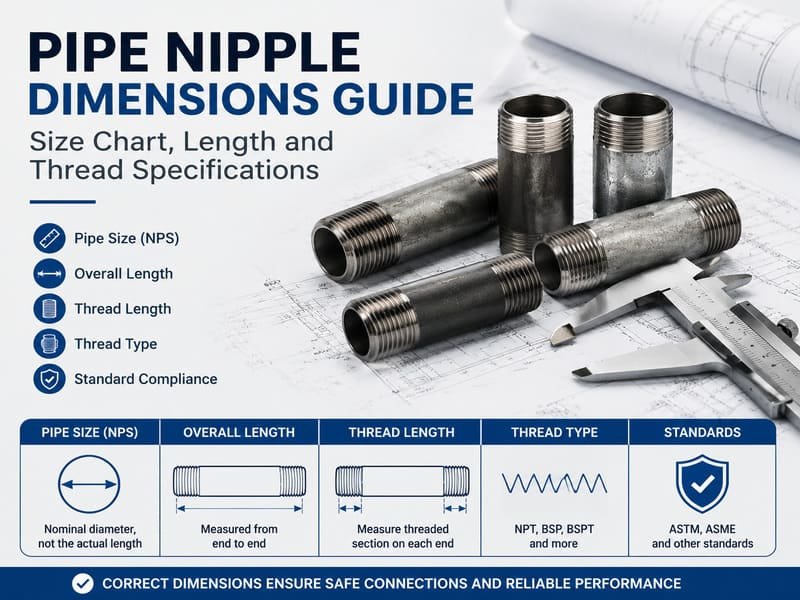
Selecting the correct pipe nipple dimensions is essential for ensuring proper connection, sealing performance, and reliable operation of a piping system.
Many buyers and engineers need to confirm several specifications before ordering pipe nipples, including:
- Pipe size
- Overall length
- Thread type
- Thread length
- Material
- Standard requirements
Although a pipe nipple may appear to be a simple short pipe section, its dimensions directly affect compatibility with fittings, valves, and other piping components.
This guide explains the key pipe nipple dimensions and how to choose the correct size for different applications.
Understanding Pipe Nipple Dimensions
Pipe nipple dimensions usually include several important measurements:
- Nominal pipe size (NPS)
- Outside diameter
- Overall length
- Thread length
- Thread standard
Each specification describes a different aspect of the product.
A correct understanding of these dimensions helps prevent ordering mistakes and installation problems.
Pipe Nipple Size Explained
What Does Pipe Size Mean?
Pipe size refers to the nominal pipe size (NPS), not the physical length of the pipe nipple.
For example:
A 1 inch pipe nipple means:
- The nominal pipe size is 1 inch
- It does not mean the nipple length is 1 inch
The actual length depends on the selected nipple specification.
Common Pipe Nipple Sizes
Pipe nipples are available in many nominal sizes.
Common sizes include:
Nominal Pipe Size | Common Applications |
|---|---|
1/8 inch | Instrumentation and small connections |
1/4 inch | Pneumatic systems and small piping |
3/8 inch | Control systems |
1/2 inch | General plumbing and industrial use |
3/4 inch | Commercial piping |
1 inch | Industrial connections |
1-1/2 inch | Larger piping systems |
2 inch and above | Heavy-duty applications |
The required size depends on:
- Flow requirements
- Pressure conditions
- Equipment connection size
Pipe Nipple Length Dimensions
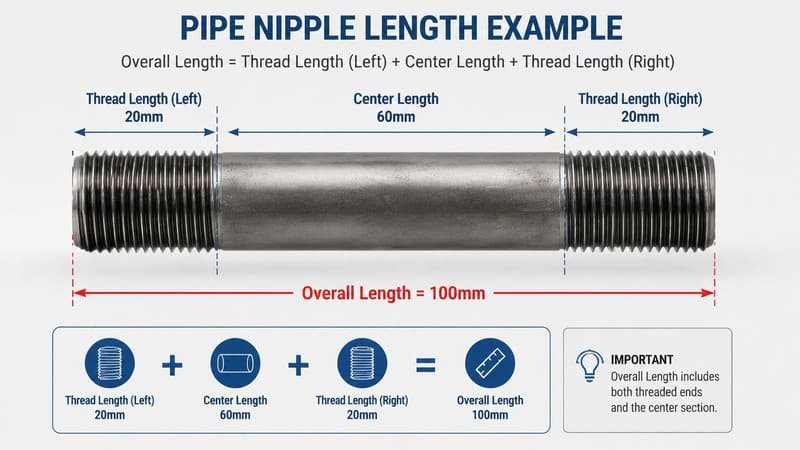
Pipe nipple length refers to the physical distance from one end to the other.
Common length measurements include:
Overall Length
Overall length is measured from end to end.
It includes:
- Left threaded section
- Center section
- Right threaded section
Formula:
Thread Length Dimensions
Thread length refers to the length of the threaded portion on each end.
Thread length affects:
- Connection depth
- Thread engagement
- Sealing performance
For standard barrel nipples, both ends usually have similar thread lengths.
Pipe Nipple Types and Their Dimension Differences
Different pipe nipple designs have different dimensional characteristics.
Close Nipple Dimensions
A close nipple has threads extending almost the entire length.
Main characteristics:
- Very short overall length
- No unthreaded center section
- Maximum thread coverage
Close nipples are commonly used where installation space is limited.
Barrel Nipple Dimensions
A barrel nipple includes:
- Threaded section on both ends
- Unthreaded center section
Dimensions are usually described as:
Barrel nipples provide more flexibility compared with close nipples.
Hex Nipple Dimensions
Hex nipples include a hexagonal center section.
Important dimensions include:
- Thread size
- Hex width
- Overall length
The hex section allows easier installation using a wrench.
Pipe Nipple Thread Specifications
Thread dimensions are another important part of pipe nipple specifications.
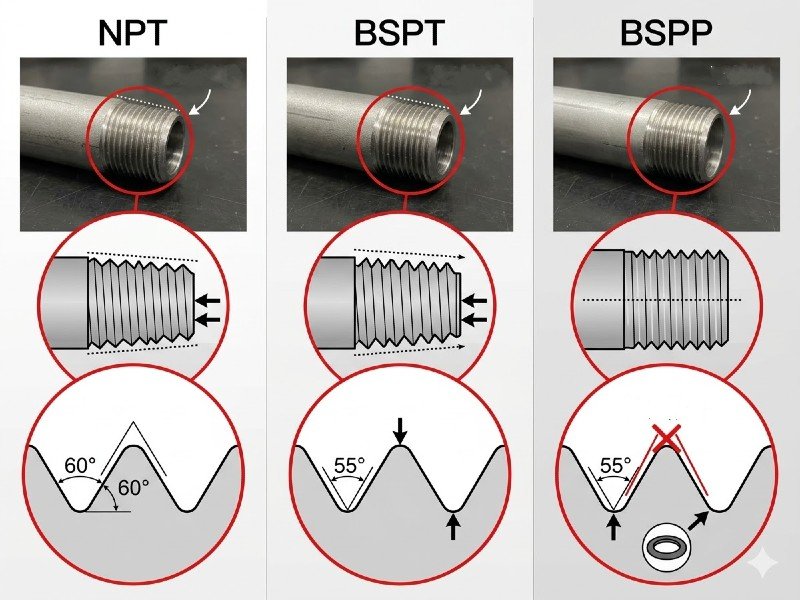
Common thread standards include:
NPT Thread Dimensions
NPT is widely used in North America.
Features:
- 60-degree thread angle
- Tapered thread
- Reliable sealing performance
BSP Thread Dimensions
BSP threads are commonly used in Europe, Asia, and international markets.
Common types:
- BSPP
- BSPT
Pipe Nipple Dimension Standards
Professional pipe nipple manufacturers typically follow industry standards.
Common standards include:
ASTM A733
Covers requirements for welded and seamless carbon steel and alloy steel pipe nipples.
ASME B1.20.1
Defines requirements for NPT thread dimensions.
How to Select the Correct Pipe Nipple Size?
Before purchasing pipe nipples, confirm the following specifications:
1. Confirm Pipe Size
Determine the required nominal pipe size.
Examples:
- 1/2 inch
- 3/4 inch
- 1 inch
- 2 inch
2. Confirm Required Length
Specify:
- Overall length
- Thread length
- Custom length requirements
3. Confirm Thread Type
Check whether your system requires:
- NPT
- BSP
- BSPT
4. Select Suitable Material
Common materials include:
- Stainless steel
- Carbon steel
- Galvanized steel
- Brass
Material selection depends on:
- Corrosion resistance
- Temperature
- Pressure requirements
Common Pipe Nipple Dimension Mistakes
Mistaking Pipe Size for Length
A 1 inch pipe nipple does not mean a 1 inch long nipple.
Pipe size refers to diameter, while length refers to physical measurement.
Ignoring Thread Dimensions
Two nipples with the same pipe size may not be interchangeable if they use different thread standards.
Measuring Only the Center Section
For barrel nipples, the overall length includes:
- Both threaded ends
- Center section
Custom Pipe Nipple Dimensions
Many industrial applications require customized dimensions.
Manufacturers can provide:
- Custom lengths
- Custom thread specifications
- Special materials
- Customer drawings
Custom pipe nipples are commonly used in:
- Oil and gas systems
- Industrial equipment
- Chemical processing
- Mechanical piping
Frequently Asked Questions
What are pipe nipple dimensions?
Pipe nipple dimensions include pipe size, overall length, thread length, and thread specifications.
Does a 1 inch pipe nipple mean the length is 1 inch?
No. A 1 inch pipe nipple refers to the nominal pipe size, not the physical length.
How is pipe nipple length measured?
Pipe nipple length is measured from one end to the other, including both threaded sections.
Are pipe nipple dimensions standardized?
Many pipe nipples follow industry standards such as ASTM A733 and ASME B1.20.1, while custom dimensions are also available.
Conclusion
Understanding pipe nipple dimensions is important for selecting the correct product for any piping application.
Before ordering, always confirm:
- Pipe size
- Overall length
- Thread dimensions
- Material
- Applicable standards
Choosing accurate dimensions ensures proper installation, reliable sealing, and long-term performance in industrial piping systems.