
Introduction
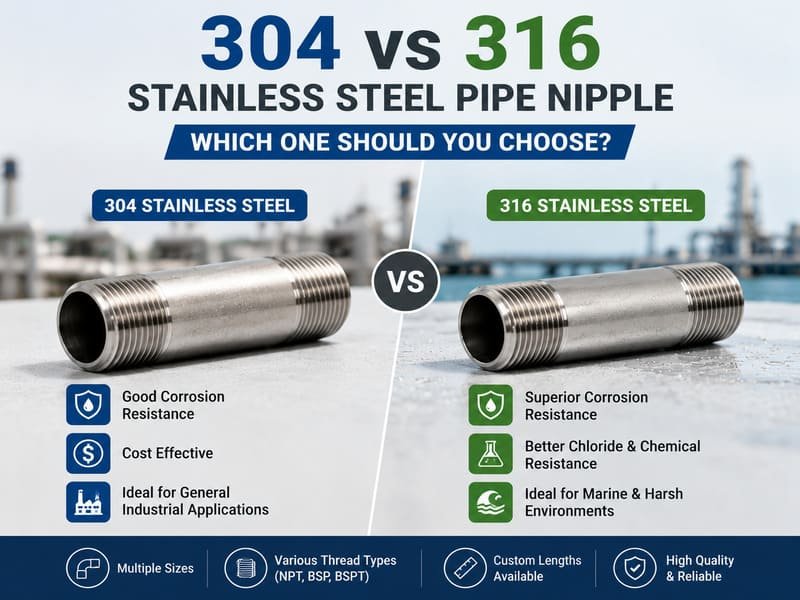
When selecting stainless steel pipe nipples, choosing the correct material grade is one of the most important decisions.
The two most commonly used stainless steel grades are:
- 304 stainless steel
- 316 stainless steel
Both materials provide excellent corrosion resistance, strength, and durability.
However, their chemical compositions and performance characteristics make them suitable for different applications.
The main difference is that 316 stainless steel provides better resistance to chlorides and harsh chemical environments, while 304 stainless steel offers a cost-effective solution for general applications.
Understanding the differences between 304 and 316 stainless steel pipe nipples helps engineers and buyers choose the right material for their piping systems.
What Are 304 and 316 Stainless Steel Pipe Nipples?
Stainless steel pipe nipples are short sections of stainless steel pipe with external threads used to connect piping components.
They are commonly manufactured using:
- Stainless Steel 304
- Stainless Steel 316
Both grades belong to the austenitic stainless steel family and are widely used in industrial piping applications.
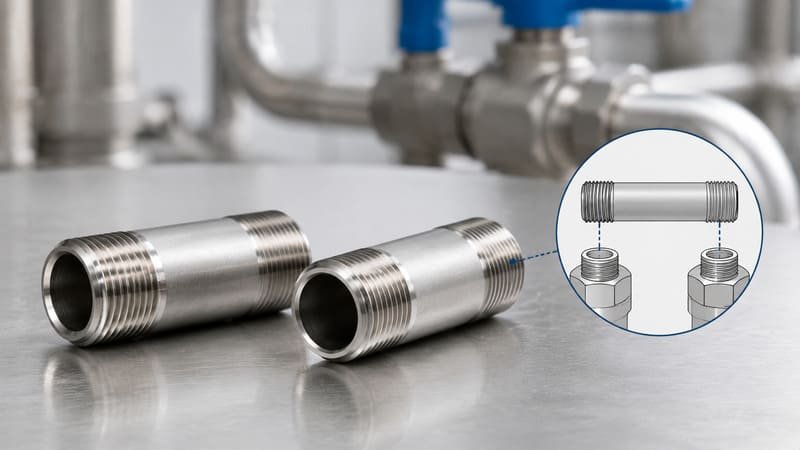
Common specifications include:
- Pipe size
- Length
- Thread type
- Surface finish
- Manufacturing standard
Chemical Composition Difference Between 304 and 316 Stainless Steel
The main difference between 304 and 316 stainless steel is their chemical composition.
304 Stainless Steel
304 stainless steel mainly contains:
- Chromium
- Nickel
The chromium content provides corrosion resistance by forming a protective oxide layer on the surface.
316 Stainless Steel
316 stainless steel contains additional molybdenum.
Molybdenum improves resistance against:
- Chlorides
- Salt water
- Chemical corrosion
This makes 316 stainless steel more suitable for aggressive environments.
304 vs 316 Stainless Steel Comparison
Feature | 304 Stainless Steel | 316 Stainless Steel |
|---|---|---|
Corrosion Resistance | Excellent | Superior |
Chloride Resistance | Moderate | Excellent |
Chemical Resistance | Good | Better |
Marine Environment | Limited | Recommended |
Cost | Lower | Higher |
General Industrial Use | Excellent | Excellent |
Harsh Environment Use | Limited | Better |
304 Stainless Steel Pipe Nipple
Advantages of 304 Stainless Steel
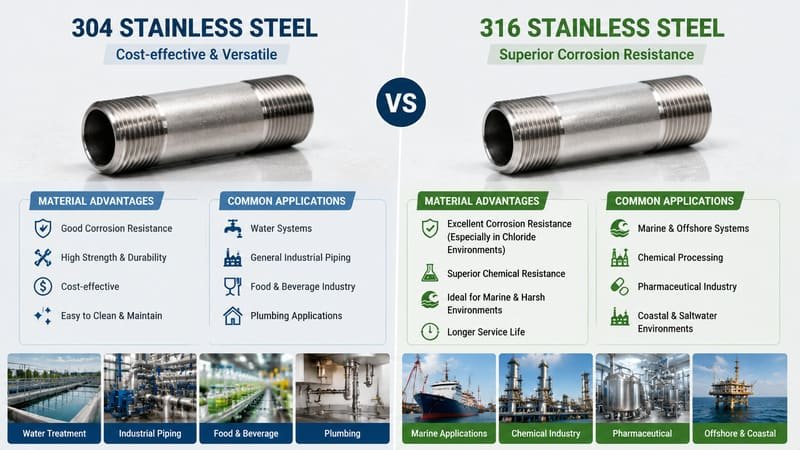
304 stainless steel pipe nipples are widely used because they provide a good balance between performance and cost.
Main advantages include:
- Excellent corrosion resistance
- Good mechanical strength
- Easy availability
- Cost efficiency
Applications of 304 Stainless Steel Pipe Nipples
304 stainless steel pipe nipples are commonly used in:
General Industrial Piping
Suitable for:
- Water systems
- Equipment connections
- General fluid transfer
Plumbing Applications
304 stainless steel provides reliable performance for many commercial and residential piping systems.
Food Processing
304 stainless steel is commonly used because of:
- Clean surface characteristics
- Good corrosion resistance
- Easy maintenance
316 Stainless Steel Pipe Nipple
Advantages of 316 Stainless Steel
316 stainless steel pipe nipples are designed for more demanding environments.
The addition of molybdenum provides improved corrosion resistance.
Main advantages include:
- Excellent chloride resistance
- Better chemical resistance
- Longer service life in harsh conditions
Applications of 316 Stainless Steel Pipe Nipples
316 stainless steel pipe nipples are commonly used in:
Marine Systems
316 stainless steel performs better in saltwater environments.
Applications include:
- Marine equipment
- Coastal facilities
- Offshore systems
Chemical Processing
Suitable for systems exposed to:
- Corrosive chemicals
- Aggressive fluids
- Industrial chemicals
Pharmaceutical Applications
316 stainless steel is often selected where high corrosion resistance and cleanliness are required.
When Should You Choose 304 Stainless Steel Pipe Nipples?
304 stainless steel is usually the right choice when:
- The environment is not highly corrosive
- Cost efficiency is important
- General industrial use is required
- Exposure to salt or chemicals is limited
Typical applications:
- Water piping
- General plumbing
- Industrial equipment
When Should You Choose 316 Stainless Steel Pipe Nipples?
316 stainless steel is recommended when:
- Chloride exposure exists
- Saltwater is present
- Chemical resistance is required
- Long service life is important
Typical applications:
- Marine systems
- Chemical plants
- Offshore equipment
- Coastal installations
304 vs 316 Stainless Steel Pipe Nipple Cost Difference
One of the biggest differences between 304 and 316 stainless steel is cost.
316 stainless steel is generally more expensive because it contains additional alloying elements, especially molybdenum.
However, the higher initial cost may provide better long-term value in harsh environments because of:
- Reduced corrosion risk
- Longer service life
- Lower maintenance requirements
How to Select Between 304 and 316 Stainless Steel Pipe Nipples?
Before selecting the material, consider:
Operating Environment
Ask:
- Is the system exposed to moisture?
- Are chemicals present?
- Is saltwater involved?
Corrosion Requirements
For normal environments:
Choose:
304 stainless steel
For aggressive environments:
Choose:
316 stainless steel
Temperature and Pressure Conditions
Both materials provide good mechanical performance, but project requirements should always be reviewed.
Industry Requirements
Some industries have specific material requirements.
Examples:
Industry | Recommended Material |
|---|---|
General plumbing | 304 |
Food processing | 304 / 316 |
Marine | 316 |
Chemical processing | 316 |
Pharmaceutical | 316 |
Stainless Steel Pipe Nipple Thread Options
Both 304 and 316 stainless steel pipe nipples can be manufactured with different thread standards.
Common options include:
NPT Thread
Widely used in North America.
BSP Thread
Common in international markets.
BSPT Thread
Used in many industrial piping applications.
Common Types of 304 and 316 Stainless Steel Pipe Nipples
Both materials are available in different designs:
Close Nipple
Features:
- Short length
- Full thread coverage
- Compact installation
Barrel Nipple
Features:
- Threaded ends
- Center pipe section
- Flexible length options
Hex Nipple
Features:
- Hexagonal center section
- Easy wrench installation
Frequently Asked Questions
Is 316 stainless steel better than 304 stainless steel?
316 stainless steel provides better corrosion resistance, especially in marine and chemical environments. However, 304 stainless steel is suitable for many general applications.
Which stainless steel pipe nipple is better for saltwater?
316 stainless steel pipe nipples are recommended because they provide better resistance to chloride corrosion.
Are 304 and 316 stainless steel pipe nipples the same size?
Yes. Both materials can be manufactured using the same pipe sizes, lengths, and thread standards. The main difference is material performance.
Is 316 stainless steel worth the extra cost?
For harsh environments, the additional cost of 316 stainless steel can be justified by improved corrosion resistance and longer service life.
Conclusion
Choosing between 304 and 316 stainless steel pipe nipples depends mainly on the operating environment and corrosion requirements.
304 stainless steel provides an excellent balance of performance and cost for general applications.
316 stainless steel offers superior corrosion resistance and is the better choice for marine, chemical, and harsh industrial environments.
By understanding the differences between these two materials, buyers and engineers can select the most suitable stainless steel pipe nipple for their specific application.