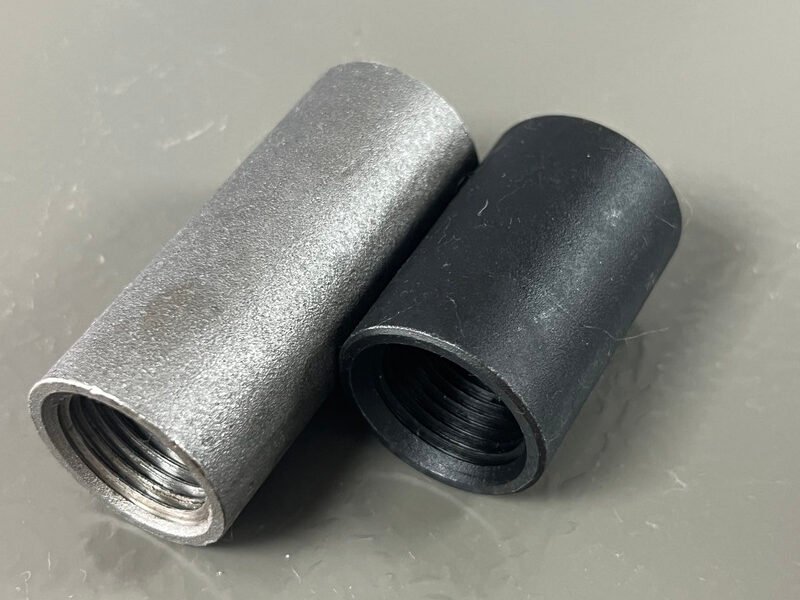
Black steel pipe couplings are industrial pipe fittings that offer cheap, reliable connections.
This guide has the most comprehensive information about specifications, applications, and installation of black steel pipe couplings.
What is a Black Steel Pipe Coupling?
The coupling is short and cylindrical.
The black pipe coupling is made from carbon steel with a dark mill-scale finish.
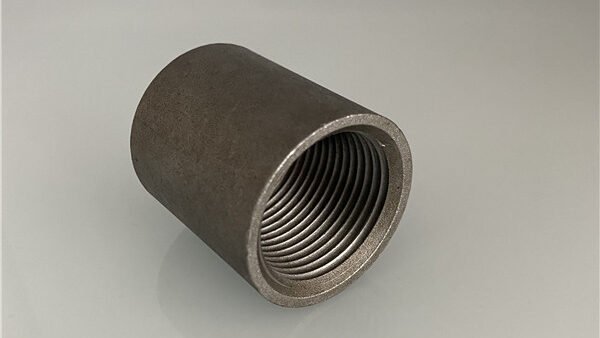
It features internal female threads on one or both ends for connecting two male-threaded pipes or fittings.
Why is it called “Black” Steel?
The term “black steel” refers to the untreated, as-rolled finish from the steel mill:
Appearance:
- Dark gray to black oxide coating (mill scale)
- Results from the hot-rolling process
- Non-uniform surface texture
- Not painted—this is the natural steel finish
Black Steel vs Galvanized Steel:
- Black steel = No zinc coating
- Galvanized steel = Hot-dip zinc coating for corrosion protection
- Black steel is more economical
- Galvanized is better for corrosion resistance
Common Misconception: “Black steel” doesn’t mean painted black. The dark color comes from iron oxide (mill scale) formed during manufacturing.
Material Specifications – Carbon Steel
Chemical Composition
Black steel couplings are typically manufactured from:
ASTM A105 Forged Carbon Steel:
| Element | Percentage |
| Carbon (C) | ≤ 0.35% |
| Manganese (Mn) | 0.60-1.05% |
| Phosphorus (P) | ≤ 0.035% |
| Sulfur (S) | ≤ 0.040% |
| Silicon (Si) | 0.10-0.35% |
| Iron (Fe) | Balance (~98%) |
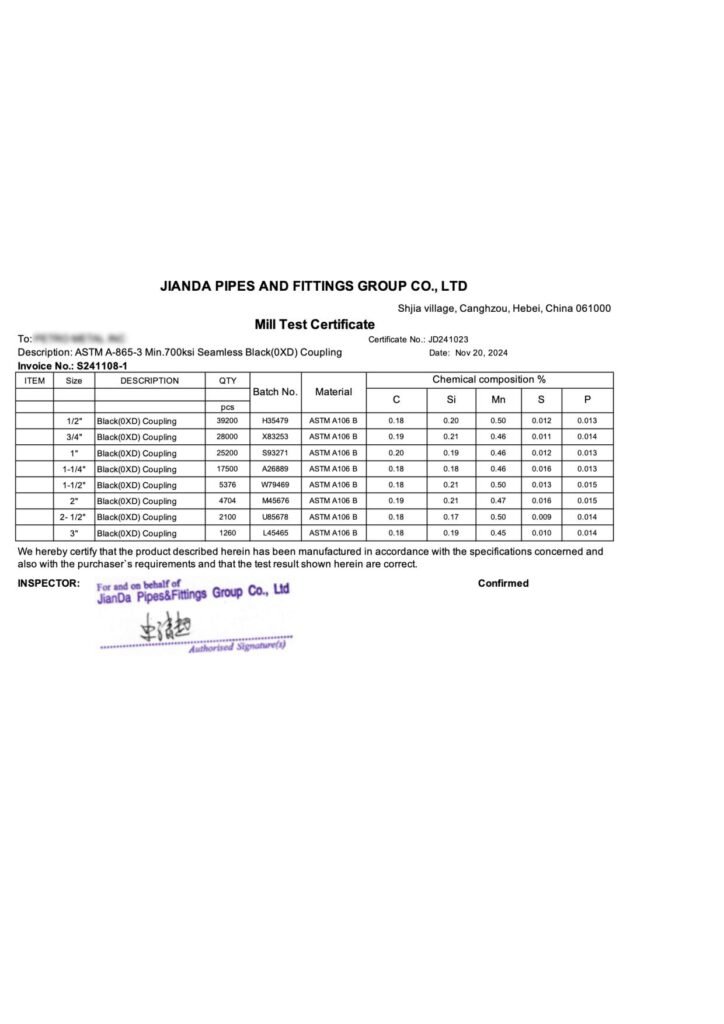
Our Carbon Steel Coupling has other Materials:
- ASTM A53 Grade B – Carbon steel pipe material
Mechanical Properties
Strength:
- Tensile Strength: ≥ 485 MPa (70,000 PSI)
- Yield Strength: ≥ 250 MPa (36,000 PSI)
- Elongation: ≥ 22% in 2 inches
- Hardness: ≤ 197 HB (Brinell)
Physical Properties:
- Density: 7.85 g/cm³ (0.284 lb/in³)
- Melting Point: ~1425-1540°C (2600-2800°F)
- Thermal Conductivity: 51.9 W/(m·K)
- Magnetic: Yes (ferromagnetic)
Temperature Range
Service Temperature:
- Minimum: -29°C (-20°F)
- Maximum: 427°C (800°F) continuous service
- Intermittent: Up to 538°C (1000°F)
Note: At temperatures above 425°C, consider alloy steel or high-temperature grades.
Types of Black Steel Couplings
Full Coupling (Standard Coupling)
Description:
- Internal female threads on both ends
- Same size threads (e.g., both 1/2″ NPT)
- Straight cylindrical or hexagonal body
- Most common type
Applications:
- Joining two pipe nipples
- Extending pipe runs
- Permanent pipe connections
- Repair of broken pipe sections
Dimensions (1/2″ NPT Example):
- Overall Length: ~60-75mm
- Hex Width: ~30mm (for wrench grip)
- Thread Depth: ~15mm each end
Reducing Coupling (Reducer Coupling)
Description:
- Two different thread sizes
- Larger thread on one end, smaller on other
- Hexagonal body for easy installation
- Transitions between pipe sizes
Common Size Combinations:
- 1″ × 3/4″
- 1″ × 1/2″
- 3/4″ × 1/2″
- 1-1/4″ × 1″
- 1-1/2″ × 1″
- 2″ × 1-1/2″
Applications:
- Reducing from main line to branch line
- Downsizing pipe diameter
- Flow control applications
- Manifold connections
Half Coupling (Socket Coupling)
Description:
- Female thread on one end only
- Socket weld or plain bore on other end
- Smaller overall length
- Used for branch connections
Types:
- Threaded-only half coupling: Female thread, plain opposite end
- Socket weld half coupling: Female thread, socket weld bore opposite
- Threaded both ends: Some designs have female threads both ends but different construction
Applications:
- Branch connections from main pipe
- Instrument and gauge connections
- Valve mounting
- Drain and vent connections
Pressure Class and Ratings
Black steel couplings are available in different pressure classes:
Class 2000 (Standard)
Pressure Rating:
- 2000 PSI @ 100°F (38°C)
- 1800 PSI @ 200°F (93°C)
- 1500 PSI @ 300°F (150°C)
Wall Thickness: Standard
Applications: General industrial, HVAC, water systems
Cost: Most economical
Class 3000 (High Pressure)
Pressure Rating:
- 3000 PSI @ 100°F (38°C)
- 2970 PSI @ 200°F (93°C)
- 2730 PSI @ 400°F (204°C)
Wall Thickness: Heavy wall Applications: Oil & gas, high-pressure steam, process piping Cost: Mid-range
Class 6000 (Extra High Pressure)
Pressure Rating:
- 6000 PSI @ 100°F (38°C)
- 5940 PSI @ 200°F (93°C)
- 5460 PSI @ 400°F (204°C)
Wall Thickness: Extra heavy wall Applications: Critical oil & gas, very high-pressure systems Cost: Premium
Important: Always verify pressure rating matches or exceeds your system requirements. Pressure ratings decrease with temperature.
Thread Standards Available
Black steel couplings can be manufactured with various thread standards:
NPT (National Pipe Tapered) – Most Common
- Standard in USA, Canada
- 60° thread angle
- 1:16 taper
- Seals on threads
BSP (British Standard Pipe)
- BSPT (Taper): 55° angle, seals on threads
- BSPP (Parallel): Seals on face with washer
- Standard in UK, Europe, Australia, Asia
DIN (German/European Standard)
- Metric threading
- ISO 7-1 compliant
- Common in European industrial equipment
SANVO can provide black steel couplings in all thread standards. Specify when ordering.
Advantages of Black Steel Couplings
Cheaper
Black steel is cheaper than other materials
- Galvanized steel: 15-20%
- Stainless steel: 40-60%
Lower material cost
- Simpler manufacturing
- Widely available raw materials
Good value for indoor applications
- Where corrosion resistance is not critical
- Dry environments
- Climate-controlled facilities
High Strength
Excellent mechanical properties
- Higher tensile strength than brass or aluminum
- Good impact resistance
- Suitable for high-pressure systems
Robust construction
- Forged fittings have a refined grain structure
- Better toughness than cast iron
- Can handle vibration and shock loads
- Wide Availability
✓ Industry standard
- Stocked by most suppliers
- Quick replacement availability
- Compatible with existing systems
✓ Multiple manufacturers
- Competitive pricing
- Various quality levels available
- Easy to source globally
- High-Temperature Capability
✓ Suitable for elevated temperatures
- Up to 427°C (800°F) continuous
- Better than plastic or brass
- Ideal for steam systems
✓ No degradation at typical operating temps
- Maintains strength up to 400°C
- No softening like non-ferrous metals
- Easy Installation
✓ Standard tools
- Pipe wrenches
- Adjustable wrenches
- No special equipment needed
✓ Hexagonal body (many models)
- Easy wrench grip
- Prevents rotation during tightening
- Can use standard socket wrenches
- Weldable
✓ Can be welded if needed
- Standard welding procedures
- SMAW, GTAW, GMAW compatible
- Allows custom modifications
Limitations and When NOT to Use Black Steel
❌ Corrosion Vulnerability
Problem:
- Mill scale provides minimal protection
- Exposed iron rusts quickly when wet
- Indoor humidity can cause surface rust
- Outdoor use leads to rapid deterioration
Solution:
- Use galvanized couplings for wet/outdoor
- Apply rust-preventive coating if needed
- Use stainless steel for corrosive environments
❌ Not Suitable for:
Outdoor Installations:
- Rain exposure causes rust
- Coastal environments = rapid corrosion
- Use galvanized or stainless instead
Potable Water Systems:
- Can rust and contaminate water
- Not approved for drinking water in many jurisdictions
- Use galvanized, brass, or stainless
Food Processing:
- Surface rust contaminates products
- Not food-grade
- Use stainless steel 304/316
Chemical Exposure:
- Acids, alkalis attack carbon steel
- No protective coating
- Use stainless steel or specialized alloys
Marine Environments:
- Saltwater causes rapid corrosion
- Mill scale doesn’t protect
- Use 316 stainless steel
High-Humidity Areas:
- Condensation causes rust
- Underground installations
- Use galvanized or coated fittings
Common Applications for Black Steel Couplings
✓ Natural Gas Piping
Why Black Steel:
- Standard for gas distribution
- Code-approved in most jurisdictions
- Dry gas = no corrosion issues
- Cost-effective for large installations
Typical Sizes:
- Residential: 1/2″, 3/4″, 1″
- Commercial: 1″, 1-1/4″, 1-1/2″, 2″
Thread Sealant:
- Yellow PTFE tape (gas-rated)
- Gas-approved pipe dope
- Never use white PTFE on gas
✓ Oil Systems
Applications:
- Hydraulic oil piping
- Lubrication systems
- Fuel oil distribution
- Industrial machinery
Advantages:
- Oil coating prevents rust
- High pressure capability
- Temperature resistant
✓ Compressed Air (Dry)
Applications:
- Air compressor discharge
- Air tool distribution
- Pneumatic controls
- Industrial air systems
Consideration:
- Only for dry air systems
- Wet air causes internal rust
- Add air dryer for best results
- Consider galvanized for outdoor runs
✓ Steam Systems
Applications:
- Process steam
- Heating steam
- Industrial boilers
- District heating
Advantages:
- High-temperature rated
- Strong enough for steam pressure
- Economical for large systems
Note:
- Condensate lines may rust—consider coated or galvanized
- Dry steam OK for black steel
- Wet steam may cause issues
✓ Fire Sprinkler Systems (Dry Pipe)
Applications:
- Dry pipe sprinkler systems
- Compressed air/nitrogen charged
- Indoor protected areas
Requirements:
- Must meet NFPA standards
- Listed and approved fittings
- Proper thread sealant
Not for wet pipe systems (use galvanized)
✓ Industrial Process Piping (Non-Corrosive)
Applications:
- Inert gas distribution
- Dry chemical powders (pneumatic conveying)
- Non-corrosive liquids in controlled environments
Installation Best Practices
Pre-Installation
- Inspect Threads:
- Check for damage, cross-threading, or debris
- Use thread gauge to verify pitch
- Ensure threads are clean and dry
- Select Proper Sealant:
For Gas:
- Yellow PTFE tape (gas-rated) OR
- Gas-approved pipe dope (not both)
- Follow local codes
For Oil:
- Standard PTFE tape OR
- Oil-resistant pipe dope
- Anaerobic sealant for high-pressure
For Air:
- PTFE tape (standard white or yellow)
- Pipe dope for larger sizes
- Ensure sealant won’t contaminate air
For Steam:
- High-temperature PTFE tape OR
- High-temp thread paste
- Verify temperature rating
- Prepare Pipes:
- Cut square with pipe cutter
- Deburr inside and outside
- Remove any oil or debris
- Ensure male threads are undamaged
Installation Steps
Step 1: Apply Thread Sealant
PTFE Tape Method:
- Hold tape against first thread
- Wrap clockwise (viewing thread end)
- Apply 3-5 wraps with slight tension
- Overlap each wrap by 50%
- Don’t cover first 1-2 threads
- Smooth tape into threads
Pipe Dope Method:
- Apply thin, even coating to male threads
- Use brush applicator for consistency
- Don’t over-apply (excess enters system)
- Apply to male threads only (not female)
Step 2: Thread First Pipe
- Hand-thread first pipe into coupling
- Thread until hand-tight
- Ensure threads engage properly (no cross-threading)
- Should thread smoothly with hand pressure
Step 3: Align Second Pipe
- Position second pipe at correct angle/orientation
- Hand-thread into opposite end of coupling
- Verify alignment before final tightening
Step 4: Tighten with Wrenches
Two-Wrench Method:
- Place one wrench on coupling hex flats
- Place second wrench on pipe
- Hold coupling stationary, turn pipe
- Tighten 2-3 turns past hand-tight
Torque Guidelines (approximate):
- 1/2″ coupling: 30-40 ft-lbs
- 3/4″ coupling: 40-50 ft-lbs
- 1″ coupling: 50-65 ft-lbs
- Larger sizes: Follow torque charts
⚠️ Don’t Overtighten:
- Can split coupling
- Damages threads
- Reduces joint integrity
Step 5: Verify Installation
- Visual inspection for alignment
- Check for gaps between coupling and pipe shoulder
- Pressure test system before operation
- Monitor for leaks during initial operation
Common Installation Mistakes
❌ Using Sealant on Both Threads:
- Apply only to male threads
- Coupling female threads should be clean
❌ Over-tightening:
- “More is better” doesn’t apply
- Follow torque specifications
❌ Cross-Threading:
- Always start by hand
- If resistance after 1-2 turns, back out and restart
❌ Wrong Sealant:
- Using white PTFE on gas (use yellow)
- Using low-temp sealant on steam
❌ Insufficient Thread Engagement:
- Need minimum 3-4 full threads engaged
- Check engagement depth
Maintenance and Service Life
Inspection Schedule
For Critical Systems (Gas, Steam, High-Pressure):
- Initial: After installation, before operation
- Monthly: First 3 months of operation
- Quarterly: First year
- Annually: After first year
For General Systems:
- Initial: After installation
- Semi-Annually: First year
- Annually: Ongoing
What to Inspect
✓ External Surface:
- Surface rust (cosmetic vs structural)
- Coating damage
- Physical damage
✓ Leak Detection:
- Visible leaks
- Pressure drop over time
- Soap bubble test for gas
✓ Thread Condition:
- If system is disassembled
- Check for stripping or wear
- Verify proper engagement
Service Life Expectations
Indoor, Dry Environment:
- Expected life: 20-30+ years
- Surface rust cosmetic only
- Minimal degradation
Indoor, Humid Environment:
- Expected life: 10-20 years
- Surface rust more significant
- Consider coating or replacement
Outdoor (Not Recommended):
- Expected life: 1-5 years
- Rapid rust and wall loss
- Use galvanized instead
Chemical Exposure:
- Variable: Depends on chemical
- Inspect frequently
- Consider a material upgrade
Quality Standards and Certifications
Manufacturing Standards
Dimensional:
- ASME B16.11 – Forged Fittings, Socket-Welding and Threaded
- MSS SP-83 – Class 3000 Steel Pipe Unions and Couplings
- ASTM A733 – Welded and Seamless Carbon Steel and Austenitic Stainless Steel Pipe Nipples
Material:
- ASTM A105 – Carbon Steel Forgings for Piping Applications
- ASTM A234 – Piping Fittings of Wrought Carbon Steel
Thread:
- ASME B1.20.1 – Pipe Threads, General Purpose (NPT)
- BS EN 10226 – Pipe threads for tubes and fittings (BSPT)
- BS EN ISO 228 – Pipe threads for non-pressure-tight joints (BSPP)
Testing and Certification
Material Certification:
- Mill Test Certificate (MTC) per EN 10204 3.1
- Chemical composition analysis
- Mechanical properties test results
Dimensional Inspection:
- Thread inspection with go/no-go gauges
- Caliper measurements
- Thread pitch verification
Pressure Testing:
- Hydrostatic testing (when specified)
- Typical test pressure: 1.5× working pressure
- Hold time: 30 seconds minimum
Our Quality Assurance:
✓ 100% dimensional inspection
✓ Material certificates provided
✓ Third-party inspection accepted (SGS, TUV, BV)
✓ Traceability to heat number
Black Steel vs Other Materials – Quick Comparison
| Feature | Black Steel | Galvanized | SS 304 | SS 316 |
| Cost | Lowest (baseline) | +15-20% | +40-50% | +50-60% |
| Corrosion Resistance | Poor | Good | Excellent | Superior |
| Outdoor Use | No | Yes | Yes | Yes |
| Strength | High | High | Moderate | Moderate |
| Temperature | Up to 800°F | Up to 400°F | Up to 1500°F | Up to 1500°F |
| Potable Water | No | Yes | Yes | Yes |
| Gas Piping | Yes | Yes | Overkill | Overkill |
| Chemical Resistance | Poor | Poor | Good | Excellent |
| Weldability | Excellent | Good | Excellent | Excellent |
| Availability | Excellent | Excellent | Good | Good |
| Service Life (indoor) | 20-30 years | 30-50 years | 50+ years | 50+ years |
How to Select the Right Size
Step 1: Determine Pipe Size
- Measure nominal pipe size (NPS)
- Verify thread type (NPT, BSP, DIN)
Step 2: Choose Coupling Type
- Full coupling: Same size both ends
- Reducing coupling: Specify both sizes (e.g., 1″ × 3/4″)
- Half coupling: For branch connections
Step 3: Verify Pressure Class
- Check system pressure and temperature
- Select appropriate class (2000, 3000, 6000)
- Include safety factor
Step 4: Specify Thread Standard
- NPT for North American equipment
- BSP for European/Asian equipment
- Verify compatibility with existing system
Common Sizes and Applications
| Size | Typical Applications |
| 1/8″ – 1/4″ | Instrument lines, air tools, gauges |
| 3/8″ – 1/2″ | Residential gas, small air systems |
| 3/4″ – 1″ | Commercial gas, HVAC, compressed air |
| 1-1/4″ – 1-1/2″ | Industrial gas, steam, and large air systems |
| 2″ – 3″ | Main distribution, high-flow applications |
| 4″ – 6″ | Large industrial, main headers |
Pricing and Ordering Information
Typical Price Range (indicative, varies by market)
Full Couplings (Class 3000):
- 1/2″: $2.50-$4.00 per piece
- 3/4″: $3.00-$5.00 per piece
- 1″: $4.00-$6.50 per piece
- 1-1/2″: $8.00-$12.00 per piece
- 2″: $12.00-$18.00 per piece
Reducing Couplings:
- Typically 10-20% more than standard couplings
Half Couplings:
- Similar to full couplings of equivalent size
Factors Affecting Price:
- Quantity (volume discounts available)
- Pressure class (6000# costs more)
- Market steel prices (fluctuate)
- Shipping location
Order from SANVO
Minimum Order Quantity (MOQ):
- Standard: 50 pieces per size
- Mixed sizes acceptable to meet MOQ
- Custom sizes: Higher MOQ (typically 100-200 pcs)
Lead Time:
- Standard sizes in stock: 7-10 days
- Non-stock standard sizes: 12-18 days
- Custom specifications: 20-30 days
What to Specify When Ordering:
- Coupling Type: Full, reducing, or half
- Size: Nominal size (e.g., “1/2 inch”)
- For reducing: both sizes (e.g., “1 inch × 3/4 inch”)
- Thread Type: NPT, BSPT, BSPP, or DIN
- Pressure Class: 2000#, 3000#, or 6000#
- Quantity: Total pieces required
- Material Certification: If MTC required
Example Order: “100 pieces, 3/4 inch NPT full coupling, black steel, Class 3000, ASTM A105 material, with mill test certificates”
Why Buy Black Steel Couplings from SANVO
Quality Assurance
✓ ISO 9001:2015 Certified Manufacturing
- Consistent quality control
- Documented procedures
- Traceable production
✓ Material Verification
- 100% material traceability
- Heat number marking
- Mill test certificates (MTC) provided
✓ Dimensional Accuracy
- CNC threading for precision
- Go/no-go gauge inspection
- Compliance with ASME B16.11
✓ Pressure Testing Available
- Hydrostatic testing upon request
- Test certificates provided
- Meets code requirements
Competitive Advantages
✓ Low MOQ – Only 50 Pieces
- Accessible for small to medium projects
- Can mix sizes to meet MOQ
- Flexible ordering
✓ Fast Delivery
- Stock items: 7-10 days
- Direct shipping to USA, Canada, Australia
- Reliable logistics partners
✓ Factory-Direct Pricing
- No intermediary markup
- Volume discounts available
- Transparent pricing
✓ Technical Support
- Engineering assistance
- Application guidance
- Thread type verification
✓ Free Samples
- Evaluate quality before bulk order
- Test fit in your system
- Verify specifications
Full Product Range
SANVO manufactures black steel couplings in:
- All standard sizes: 1/8″ to 6″
- All thread types: NPT, BSP, DIN
- All pressure classes: 2000#, 3000#, 6000#
- All types: Full, reducing, half couplings
Also available:
- Black steel pipe nipples (matching couplings)
- Galvanized steel couplings
- Stainless steel couplings (304, 316, 316L)
- Custom manufacturing services
FAQ
Q: Can black steel couplings be used outdoors?
A: Not recommended. Black steel rusts quickly when exposed to rain and humidity. Use hot-dip galvanized or stainless steel couplings for outdoor installations.
Q: What’s the difference between black steel and black iron?
A: They’re the same material—carbon steel with a black mill-scale finish. “Black iron” is a colloquial term, but technically it’s carbon steel, not pure iron.
Q: Do I need to paint black steel couplings?
A: For indoor dry applications, no. For humid or potentially wet areas, applying rust-preventive paint or coating can extend service life.
Q: Can black steel be used for potable water?
A: Generally not recommended. Black steel can rust and contaminate drinking water. Most plumbing codes require galvanized, brass, copper, or plastic for potable water.
Q: What thread sealant should I use on gas lines?
A: Use yellow PTFE tape rated for gas service, or gas-approved pipe dope. Never use standard white PTFE tape on gas—it’s not rated for hydrocarbon exposure. Always follow local codes.
Q: How many threads should engage in a coupling?
A: Minimum 3-4 full threads for proper seal and strength. NPT threads typically engage 5-7 threads when properly tightened.
Q: Can I weld black steel couplings?
A: Yes, carbon steel is weldable using standard procedures. However, consider using weld fittings instead if a permanent welded connection is needed.
Q: What’s the difference between Class 3000 and Class 6000?
A: Wall thickness and pressure rating. Class 6000 has thicker walls and can handle twice the pressure of Class 3000. Use Class 6000 for high-pressure applications (oil & gas, process piping).
Q: How do I remove a stuck coupling?
A:
- Apply penetrating oil and wait 30 minutes
- Use two pipe wrenches (one on each pipe)
- Apply heat carefully if safe (not for gas lines!)
- If threads are damaged, cut the pipe and replace it
Q: Do we provide mill test certificates?
A: Yes. Our black steel couplings offer MTC, showing chemical composition and mechanical properties. Third-party inspection (SGS, TUV, BV) is also accepted.
Conclusion
Black steel pipe couplings provide a tight, reliable connection with threads but are unsuitable for corrosive environments.
Understanding their advantages, limitations, and proper installation techniques ensures long-lasting, leak-free connections.
Key Takeaways:
✓ Best for: Indoor, dry environments—gas, oil, compressed air, steam
✓ Cost-effective: Most economical coupling option
✓ High strength: Suitable for high-pressure and high-temperature
✓ Easy to install: Standard tools and techniques
✓ Not for: Outdoor, wet, corrosive, or potable water applications
When in doubt, consider these alternatives:
- Wet/outdoor: Galvanized steel couplings
- Corrosive: Stainless steel 316 couplings
- Potable water: Galvanized, brass, or stainless
Ready to Order Black Steel Couplings?
Contact SANVO Today:
📧 Email: office@pipesandfittings.com
- Specify sizes, quantities, and thread type
- Request a quote with MTC
📞 Phone/WhatsApp: +86 13603173851
- Technical support
- Application consultation
- Fast quotations
🎁 Free Sample Program:
- Test quality before bulk order
- Verify thread compatibility
- No obligation
SANVO Advantages:
✓ ISO 9001 certified quality
✓ MOQ only 50 pieces
✓ All sizes 1/8″ to 6.”
✓ NPT, BSP, DIN threads available
✓ Class 2000, 3000, 6000
✓ Fast delivery to the USA, Canada, Australia
✓ Competitive factory-direct pricing