
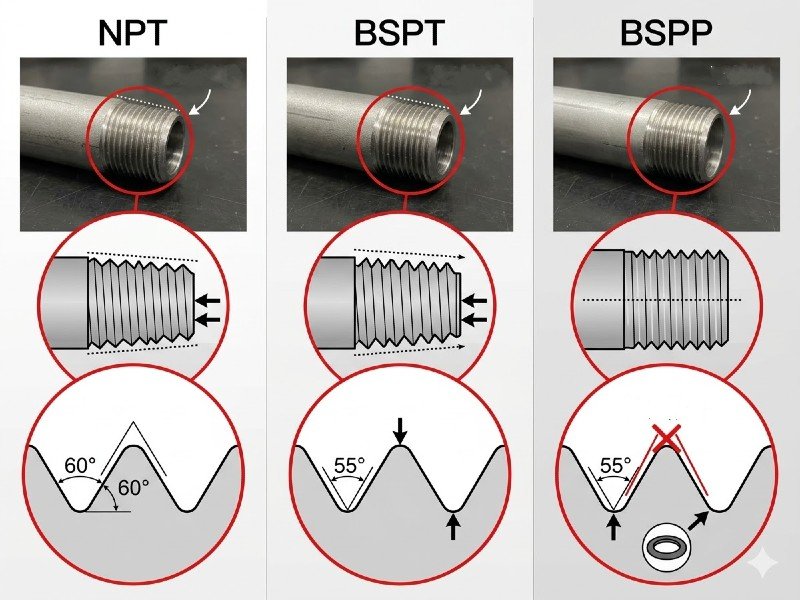
Thread standards are one of the most critical factors when selecting pipe nipples.
The wrong thread type can lead to leakage, incompatibility, or even system failure.
This guide explains and compares NPT vs BSP pipe threads.
1. What is the NPT Thread?
NPT (National Pipe Thread) is the standard tapered thread used mainly in the United States.
- Standard: ANSI/ASME B1.20.1
- Thread angle: 60°
- Type: Tapered (both male and female threads taper)
- Sealing method: Thread deformation + sealant (PTFE tape or pipe dope)
Key Characteristics
- Creates a mechanical seal through thread interference
- Widely used in North American plumbing, oil & gas, and industrial piping
- Not designed for repeated disassembly in high-pressure sealing without sealant
2. What Is BSP Thread?
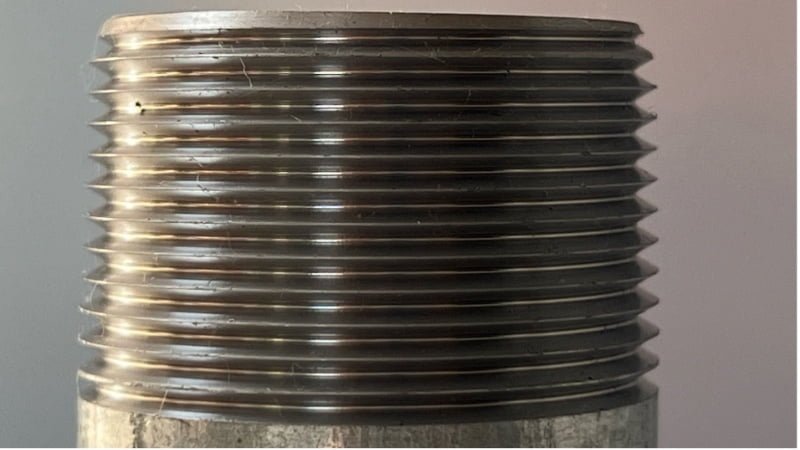
BSP (British Standard Pipe) is a thread standard commonly used in Europe and many Commonwealth countries.
- Standard: ISO 7-1 (BSPT), ISO 228 (BSPP)
- Thread angle: 55°
- Types:
- BSPT (Tapered) – seals on threads
- BSPP (Parallel) – seals using O-ring or gasket
Key Characteristics
- BSPP requires a sealing washer or O-ring
- BSPT is similar in function to NPT, but not interchangeable
- More commonly used in metric-based industrial systems
3. NPT vs BSP: Key Technical Differences
3.1 Thread Angle
- NPT: 60°
- BSP: 55°
This difference alone makes them physically incompatible in most cases.
3.2 Thread Type
- NPT: Always tapered
- BSP: Can be tapered (BSPT) or parallel (BSPP)
3.3 Sealing Method
- NPT: Thread interference + sealant
- BSPT: Thread sealant (similar to NPT but different geometry)
- BSPP: Mechanical seal using O-ring or gasket
3.4 Standard Systems
- NPT: US standard (ANSI/ASME)
- BSP: UK/ISO standard (ISO 7-1, ISO 228)
3.5 Interchangeability
| Combination | Compatibility |
|---|---|
| NPT + BSPT | Not recommended |
| NPT + BSPP | Not compatible |
| BSPT + BSPP | Not compatible |
Even if they appear to “fit,” the risk of leakage is high.
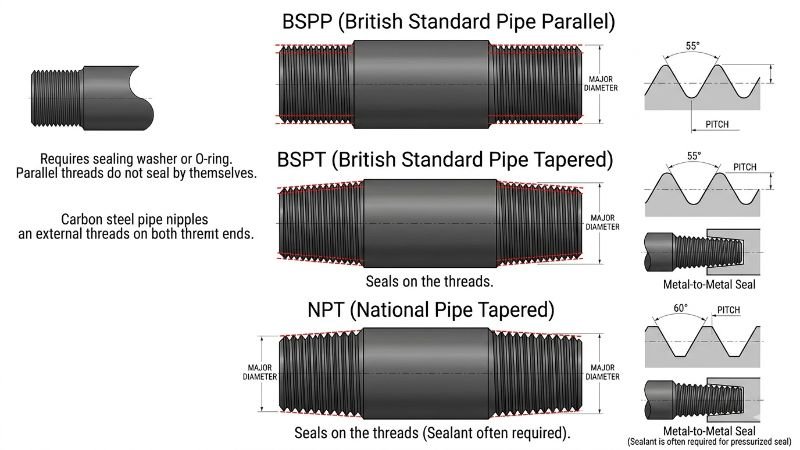
4. Visual Comparison
- NPT relies on 60° tapered wedge sealing
- BSP relies on 55° geometry + optional gasket/O-ring sealing
This subtle geometric difference is the root cause of incompatibility.
5. Regional Usage Differences
- NPT: USA, Canada, parts of South America
- BSP: UK, Europe, China, Australia, Middle East, Africa (widely adopted ISO system)
In global sourcing, this is one of the most common specification mismatches in pipe fittings and industrial equipment.
6. How to Choose Between NPT and BSP
6.1 Check Your System Standard First
The most important rule is:
Always match the existing system standard.
- Existing US piping → use NPT
- Existing ISO/metric piping → use BSP
6.2 Consider Equipment Origin
- American-made equipment → likely NPT
- European/Asian equipment → likely BSP
6.3 Check Sealing Requirements
- High-pressure gas or oil systems → prefer tapered threads (NPT or BSPT)
- Low-pressure or hydraulic control systems → BSPP with O-ring often preferred
6.4 Avoid Cross-Threading Risks
Never force NPT into BSP or vice versa. Even if it initially engages:
- Thread damage may occur
- Seal failure is highly likely
- Safety risk increases in gas/oil systems
7. Common Mistakes in Industry
Mistake 1: Assuming “1/2 inch” means compatible
Nominal size is not enough—thread form matters more.
Mistake 2: Mixing standards in procurement
Many leakage issues come from mixed sourcing of fittings.
Mistake 3: Ignoring sealing method differences
BSPP is often mistaken as “just another BSPT,” but it requires O-ring sealing.
8. Expert Recommendations
Based on industrial piping practice:
- Always verify the thread standard using gauges before installation
- Use manufacturer specification sheets, not visual inspection
- Standardize procurement (do not mix BSP and NPT in one system)
- Train installation teams on thread identification
These practices are widely used in oil & gas, fire protection, and hydraulic industries to reduce failure risk.
9. FAQ
Q1: Can BSP and NPT be used together with tape?
No. PTFE tape does not solve geometric mismatch.
Q2: Which is better, NPT or BSP?
Neither is “better”—they are different standards used in different regions.
Q3: How can I identify thread type?
Use:
- Thread gauge
- Angle measurement (55° vs 60°)
- Standard marking from the manufacturer
10. Conclusion
The difference between NPT and BSP threads is not just technical—it directly impacts safety, sealing performance, and system compatibility.
- NPT = 60° US tapered standard (ASME)
- BSP = 55° ISO/UK standard (BSPT/BSPP)
Correct selection ensures leak-free performance and avoids costly installation errors.