Introduction
In oil & gas processing, midstream transport, and industrial plant operations, threaded plumbing fittings are often critical and the last thing project managers budget for carefully. Corrosive media, high-cycle pressure fluctuations, and temperature swings accelerate wear on low-grade fittings, triggering unplanned shutdowns that cost far more than the fittings themselves.
This guide is written for procurement engineers, project managers, and plant equipment teams who need to specify and source pipe nipples and pipe couplings that meet system demands — without overpaying or waiting months for delivery. We cover fitting selection by application, material trade-offs, realistic quantity estimates by project scale, and actionable cost-reduction tactics drawn from real-world field scenarios.
Which Pipe Fittings Are Used in Oil & Gas Systems
Oil & gas facilities involve multiple fluid types (crude oil, natural gas, produced water, steam, chemicals), each with distinct pressure and corrosion profiles. Below are the primary pipe fitting types used, with recommended materials and engineering rationale.
| Type | Primary Application | Recommended Material | Key Engineering Reason |
| Close Nipple / Pipe Nipple | Short connections between valves, gauges, and flanges | Carbon Steel A106 / SS 316 | Handles 3,000+ PSI; SS for H₂S or brine service |
| Full Coupling & Half Coupling | Joining two pipe sections inline, repair sleeves | Carbon Steel / SS 304 | Full coupling for new lines; half coupling for branch taps |
| Reducing Coupling | Connecting pipes of different diameters without fittings stack | Carbon Steel | Reduces pressure drop vs. bushing + nipple combo |
| Hex Nipple | Instrument connections, tight-access manifolds | Stainless Steel 316L | Corrosion resistance for chemical injection lines |
| Barrel Nipple / Threaded Nipple | Header-to-equipment connections; blowdown lines | Carbon Steel Schedule 80 | Heavy wall for abrasive or high-velocity service |
Note: For sour gas service (H₂S environments), all carbon steel components must comply with NACE MR0175 / ISO 15156 hardness requirements. Verify with your metallurgist before specifying.
Project Scale & Quantity Reference Guide
Use the following estimates as a starting framework for budgeting and sourcing discussions. Actual quantities vary by system complexity, pipe diameter mix, and redundancy requirements.
| Project Scale | Typical Scope | Pipe Nipple Qty | Coupling Qty | Selection Notes |
| Small | Pump stations, compressor packages, metering skids | 50–300 pcs | 20–80 pcs | Prioritize SS for corrosive media; standard NPT; Schedule 80 minimum |
| Medium | Separation trains, injection systems, heat exchanger banks | 300–1,500 pcs | 80–400 pcs | Mix of CS and SS by zone; consider swage nipples at reductions; verify NACE if sour |
| Large | Refineries, petrochemical plants, offshore platforms | 1,500–10,000+ pcs | 400–2,500+ pcs | Standardize on 2–3 nipple lengths per size; bulk purchase 6–12 months forward |
Procurement tip: For medium-to-large projects, request size-by-size breakdowns from your piping isometric takeoffs rather than estimating. Even a ±15% error on a 3,000-piece order creates significant cost variance.
How to Reduce Fitting Costs Without Compromising System Integrity
1. Standardize on Two or Three Nipple Lengths per Bore Size
Many facilities end up with 8–10 different nipple lengths in the same pipe size due to ad-hoc procurement. Consolidating to close, short (1.5″), and standard (3–4″) lengths for each diameter reduces SKU count, simplifies inventory, and increases your order volumes per item — typically unlocking 10–18% unit price reductions through volume breaks.
2. Use Carbon Steel in Low-Risk Zones, SS Only Where Required
Specifying SS 316 across an entire facility when only 30–40% of lines carry corrosive media is a common over-engineering error. Segregate your P&ID by fluid type and corrosion potential. Carbon steel Schedule 80 nipples are appropriate for clean utility gas, instrument air, and non-corrosive cooling water lines — and cost 45–65% less per unit than SS equivalents. Apply SS selectively where chlorides, acids, or H₂S are present.
3. Consolidate Purchase Quantities Across Project Phases
Projects with phased construction timelines often procure fittings in three or four separate purchase orders. Consolidating even 60–70% of projected quantities into a single initial order can reduce per-unit pricing by 12–22%, and more importantly, locks in lead times for the full project lifecycle. For pipe nipples and couplings specifically, manufacturers can typically commit inventory against a blanket purchase order with phased release schedules.
4. Replace Stacked Assemblies with Swage Nipples
A bushing threaded into a coupling with a nipple through-run creates three threaded joints, where one swage nipple creates zero intermediate joints. Each eliminated threaded joint removes a potential leak point and reduces assembly labor by approximately 15 minutes per connection. On a 200-point reduction manifold, which represents roughly 50 hours of saved installation labor, plus reduced long-term leak maintenance exposure.
5. Require Full Material Traceability from Suppliers
Fittings without mill certificates or heat traceability carry hidden costs: failed inspection, project delays, and potential rework when third-party QC rejects unmarked components. Specify ASTM material compliance, heat number traceability, and dimensional conformance to ASME B1.20.1 (NPT threads) on all purchase orders. Reputable manufacturers include this documentation at no additional cost — if a supplier cannot provide it, the apparent price savings will likely be offset elsewhere in the project.
Material Selection Quick-Reference Chart
Use this table as a first-pass screening tool when specifying pipe nipples and couplings for common industrial service conditions.
| Service Condition | Media / Temp / Pressure | Recommended Material | Avoid | Reason |
| Standard process gas (dry) | Natural gas, <200°F, <600 PSI | Carbon Steel A106 / A53 | Galvanized steel | GI coatings degrade above 150°F; CS is adequate for dry gas |
| Produced water/brine | High Cl⁻, <180°F, <300 PSI | SS 316L | Carbon steel, SS 304 | 304 susceptible to chloride SCC; 316L required |
| Chemical injection lines | Acids, inhibitors, methanol, <300°F | SS 316L | Carbon steel | Corrosion rate unacceptable in CS for most chemical service |
| Utility air/instrument air | Dry compressed air, <150°F, <150 PSI | Carbon Steel / Galvanized | SS 316 | No corrosion risk; SS adds unnecessary cost |
| Cryogenic / LNG service | LNG, <−100°F | SS 304L / 316L (low-temp grade) | Standard CS | CS becomes brittle below −20°F; austenitic SS retains toughness |
FAQ: Pipe Nipples & Couplings for Industrial Applications
Q: What is the difference between a pipe nipple and a pipe coupling?
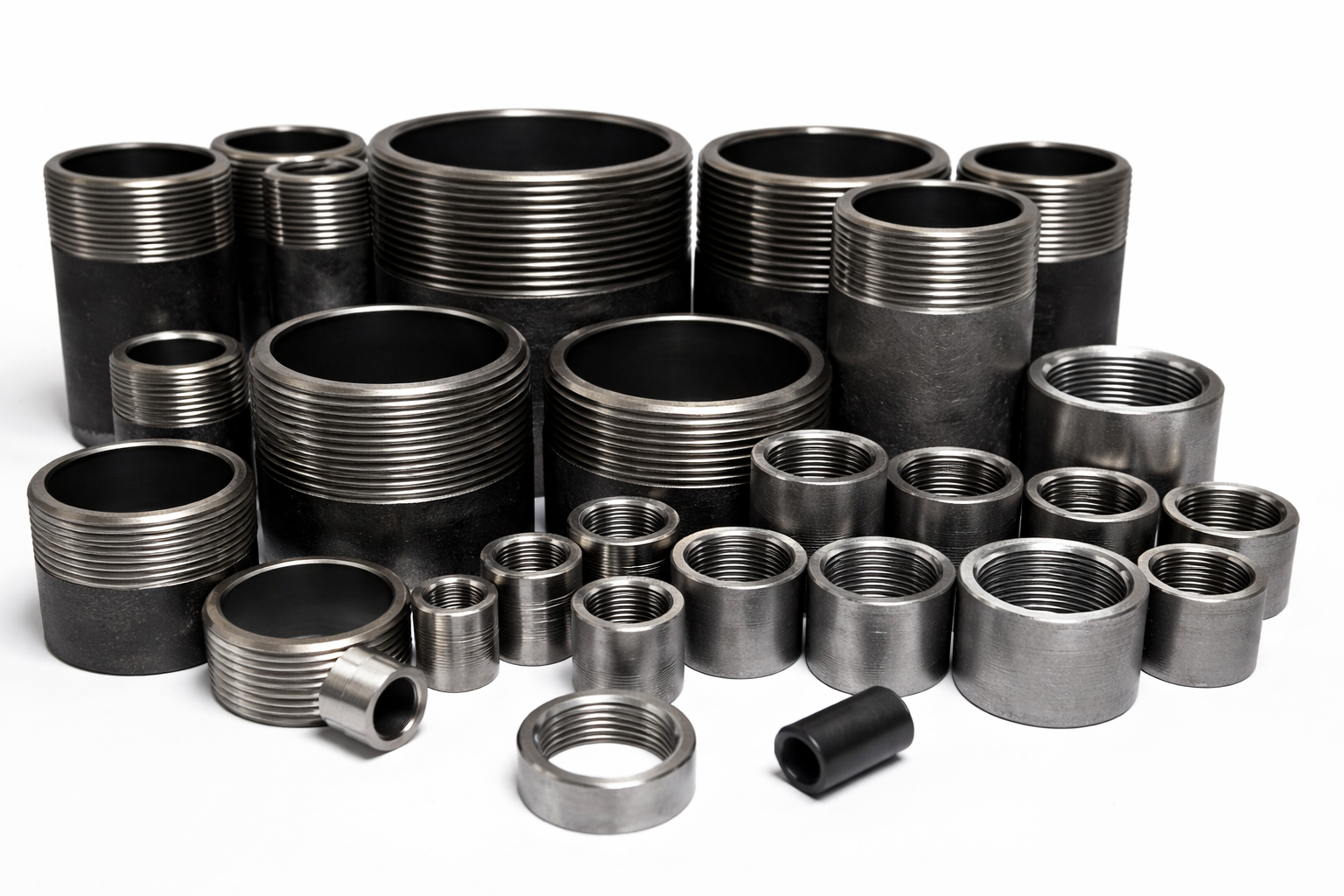
A pipe nipple is a short length of pipe with male (external) threads on both ends, used to connect fittings or equipment. A pipe coupling is a short fitting with female (internal) threads on both ends, used to join two pipes or nipples in-line. They function as a complementary pair in threaded piping systems.
Q: When should I specify Schedule 80 nipples instead of Schedule 40?
Schedule 80 nipples have a thicker wall, which means the threaded section (where wall thickness is reduced by thread cutting) retains more structural integrity. For any service with pressure above 300 PSI, corrosive media, or vibration-prone locations (pump discharge, compressor outlets), Schedule 80 is the appropriate baseline specification. Schedule 40 is acceptable only for low-pressure utility services.
Q: Can pipe nipples and couplings be used in high-temperature steam systems?
Standard carbon steel and stainless steel fittings are rated for steam service, but temperature limits matter. A106 carbon steel is appropriate up to approximately 400°F.
Q: What lead times should I expect for pipe nipples and couplings from a China-based manufacturer?
Standard carbon steel and stainless steel nipples and couplings in sizes from 1/4″ to 12″ NPT are typically available from stock or produced within 10–20 working days for standard quantities. For large orders (10,000+ pieces), custom material, or special inspection requirements (PMI, hydro test), allow 25–40 days.
Q: How do I verify thread quality on imported pipe nipples?
Specify conformance to ASME B1.20.1 for NPT threads and require dimensional inspection reports with each shipment. For critical service, request thread gauge inspection certificates. Reputable manufacturers will provide this documentation as standard practice. If a supplier cannot provide gauge inspection records, that is a meaningful quality red flag regardless of price.
Ready to Specify or Source Your Next Plumbing Fitting Order?
If you’re in the early stages of a project takeoff, we can review your requirements and provide a material recommendation. If you already have a specification sheet, send it over for a formal quotation — our engineering team typically responds within 24 hours.
We supply pipe nipples and pipe couplings in carbon steel and stainless steel (304 / 304L / 316 / 316L) in sizes 1/8″ through 12″ NPT and BSP, Schedule 40 through XXS. All materials are supplied with mill certificates and dimensional inspection reports as standard.
| 📋 Request a Quote Send your BOM or specs for a formal quotation with pricing and lead time within 24 hours. | 📞 Talk to an Engineer Not sure which grade fits your application? Our engineers review project specs and advise on material selection — no obligation. |
Not sure which fitting grade fits your project specs? Our engineering team reviews project requirements within 24 hours.