A single wrong specification can bring a production line to a halt — or worse, create a safety hazard that costs far more than the parts themselves.
Yet most pipe nipple procurement mistakes happen before the purchase order is ever submitted.
This guide covers the seven most common errors, why they happen, and what to do instead.
1. Selecting the wrong material for the application
Carbon steel is the default choice for many buyers — it’s widely available, competitively priced, and works well in a broad range of systems.
The problem arises when it’s specified for environments where it will fail rapidly: corrosive fluids, saltwater, acidic chemicals, or high-humidity outdoor installations.
The consequence isn’t just premature replacement.
In pressurized systems, material degradation leads to leaks, burst fittings, and serious safety incidents.
The cost of a project shutdown almost always dwarfs any savings from choosing the cheaper material.
| Material | Best For | Avoid When | Relative Cost |
|---|---|---|---|
| Carbon steel | Steam, compressed air, general water lines | Corrosive chemicals, marine environments | Low |
| 304 Stainless | Food processing, light chemicals, and outdoor | High-chloride environments | Medium |
| 316 Stainless | Seawater, acids, and pharmaceutical | High-temperature dry gas | Medium-high |
| Brass | Potable water, HVAC, natural gas | Ammonia, high-pressure steam | Medium |
| Galvanized steel | Outdoor structural, general plumbing | Hot water systems, steam (zinc leaching) | Low–medium |
How to avoid it?
2. Confusing nominal pipe size (NPS) with actual outer diameter
Nominal pipe size is a dimensionless reference number — a 1″ NPT nipple does not have a 1-inch outer diameter.
For sizes up to 12 inches, the actual OD is always larger than the nominal designation.
Buyers who assume nominal equals physical dimension will order parts that don’t connect properly, causing project delays and excess inventory.
| NPS (Nominal) | Actual OD (inches) | Common Mistake |
|---|---|---|
| 1/4″ | 0.540″ | Assumed 0.250″ OD |
| 1/2″ | 0.840″ | Assumed 0.500″ OD |
| 1″ | 1.315″ | Assumed 1.000″ OD |
| 2″ | 2.375″ | Assumed 2.000″ OD |
How to avoid it?
3. Mixing up NPT and BSP thread standards
NPT (National Pipe Taper) and BSP (British Standard Pipe) threads look nearly identical at a glance and share close thread-per-inch counts in some sizes, which makes the mix-up dangerously easy.
The critical difference: NPT uses a 60° thread angle, BSP uses 55°.
The two standards are not interchangeable.
Forcing them together produces a connection that appears tight but will leak or fail under pressure.
This error is especially common in international projects where equipment from multiple regions is combined, or when ordering from distributors who stock both standards without clear labeling.
How to avoid it?
Identify the thread standard in your system using OEM documentation or a thread gauge before ordering.
Specify the full standard on every purchase order — e.g., “1” NPT” or “1” BSPP”, not just the size.
For mixed-standard systems, use certified adapters rather than forcing a direct connection.
4. Ignoring pressure ratings and schedule numbers
Wall thickness — expressed as a “Schedule” number — determines how much internal pressure a nipple can safely handle.
Schedule 40 is standard for low- to moderate-pressure applications.
Schedule 80 has thicker walls and handles significantly higher pressures.
Using a Schedule 40 nipple in a high-pressure system is a structural failure waiting to happen.
Equally important: pressure ratings are temperature-dependent.
A nipple rated at 1,500 PSI at room temperature may only be rated at 600 PSI at 400°F.
Buyers who specify pressure without specifying temperature are working with incomplete information.
| Schedule | Wall Thickness (1″ NPS) | Approx. Max Pressure | Typical Use |
|---|---|---|---|
| Sch 40 | 0.133″ | ~1,450 PSI (carbon steel) | General plumbing, low-pressure systems |
| Sch 80 | 0.179″ | ~2,000 PSI (carbon steel) | High-pressure steam, industrial lines |
| Sch 160 | 0.250″ | ~3,000 PSI (carbon steel) | Extreme pressure, hydraulic systems |
| XXS | 0.358″ | ~4,500 PSI (carbon steel) | Ultra-high-pressure, specialized industrial |
How to avoid it?
Specify both the schedule number and maximum operating conditions (pressure AND temperature) on every order.
For high-pressure systems, request the manufacturer’s P-T rating documentation and verify it against your actual operating parameters.
Refer to ASME B16.11 and applicable ASTM material standards.
5. Choosing the wrong nipple length
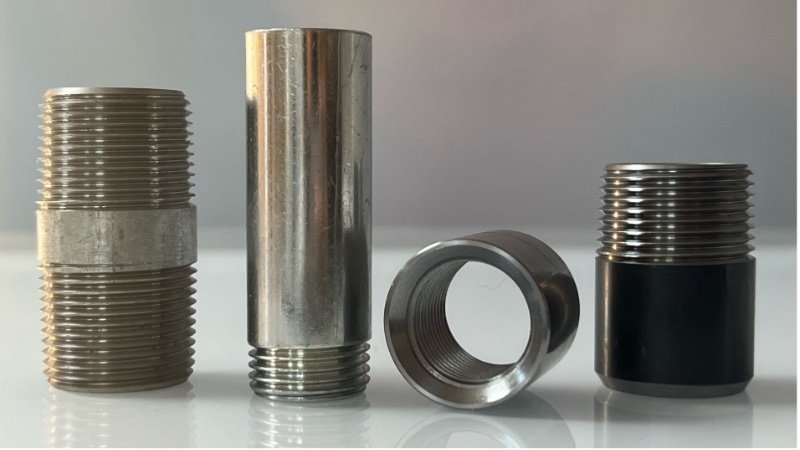
Pipe nipples come in four standard length configurations — Close, Short, Long, and Hex — each serving a different purpose.
Closed nipples have no unthreaded center; the two threaded ends meet in the middle.
This makes them compact but impossible to remove with a standard wrench once installed.
Using the wrong length leads to assembly problems, component interference, or blocked maintenance access.
| Type | Description | Best For |
|---|---|---|
| Close | No exposed center pipe; threads meet in the middle | Tight-clearance joints where disassembly is rare |
| Short | Short unthreaded center section | General plumbing; minimal wrench purchase |
| Long | Longer unthreaded center for wrench access | Valve assemblies, manifolds, serviceable systems |
| Hex | Hexagonal center for easy wrench grip | High-torque applications; easy install and removal |
How to avoid it?
6. Overlooking surface treatment requirements
Surface treatment is often treated as a cosmetic detail, but it’s a functional requirement.
Hot-dip galvanizing provides excellent outdoor corrosion protection for carbon steel — but introduces zinc into the system, which is problematic for hot water and steam applications where zinc leaches and accelerates internal corrosion.
Epoxy-lined nipples may be required by code for potable water systems.
Buyers often default to galvanized without checking whether it suits their fluid and temperature range.
| Surface Treatment | Best For | Avoid When | Standard |
|---|---|---|---|
| Black (bare) steel | Dry indoor systems, steam | Outdoor, wet, corrosive environments | ASTM A733 |
| Hot-dip galvanized | Outdoor, structural, cold water | Steam, hot water systems | ASTM A153 |
| Epoxy-lined | Potable water, municipal systems | High-temperature applications | NSF 61 |
| Stainless (no coating) | Corrosive fluids, food/pharma | Budget-sensitive general use | ASTM A312 |
How to avoid it?
7. Focusing only on unit price while ignoring total cost
This is the mistake that connects all the others.
Procurement decisions driven purely by unit price miss the largest cost drivers: premium freight on urgent re-orders, re-inspection costs when certification documents are missing, and rework costs when incorrect specifications reach the job site.
A nipple that costs 15% less from a supplier who can’t provide mill test reports, can’t meet your lead time, or ships non-conforming parts is never actually cheaper.
The cost of a single bad delivery on a time-sensitive project typically exceeds the total annual savings from the unit price difference.
| Cost Factor | Often Missed? | Impact Level |
|---|---|---|
| Unit price | No — visible at ordering | Low |
| Freight / MOQ charges | Often | Medium |
| Lead time premium (urgent re-orders) | Often | High |
| Missing certification / re-inspection | Yes | High |
| Non-conforming delivery rework | Yes | Critical |
| Downtime from wrong spec on-site | Yes | Critical |