
Introduction
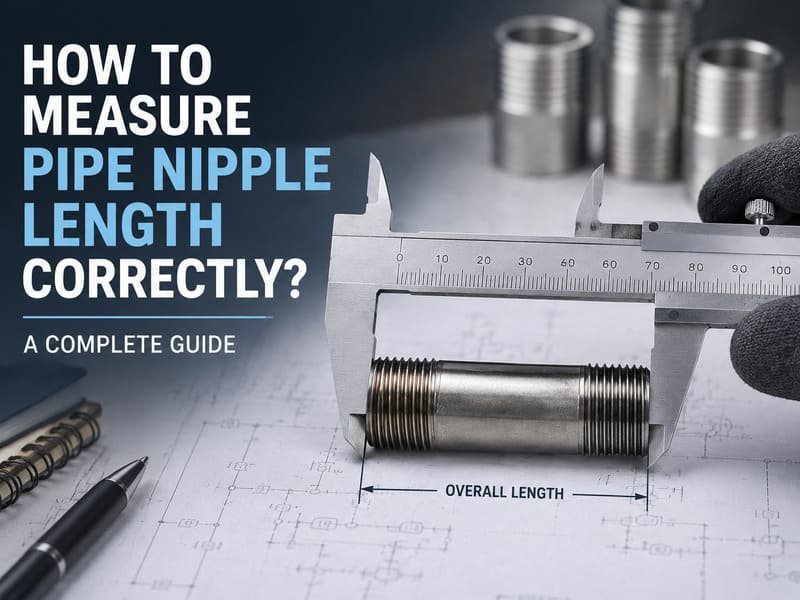
Pipe nipple length is one of the most important specifications when selecting a pipe nipple for a piping system.
Although pipe nipples may look like simple short pipe sections, incorrect length selection can cause installation problems, connection failure, and unnecessary replacement costs.
Many buyers and engineers ask:
- How to measure pipe nipple length?
- Does the thread length count as the total length?
- What is the difference between overall length and effective length?
- How do you select the correct nipple length?
Understanding the correct measurement method helps ensure compatibility between pipes, fittings, valves, and other components.
What Is Pipe Nipple Length?
Pipe nipple length refers to the physical length of the nipple used in a piping connection.
Depending on the application and industry standard, pipe nipple length can be described in several ways:
- Overall length
- Thread length
- Effective length
- Center-to-center connection length
Different manufacturers and buyers may use different measurement methods, so confirming the required definition is important before ordering.
Understanding Different Pipe Nipple Measurements
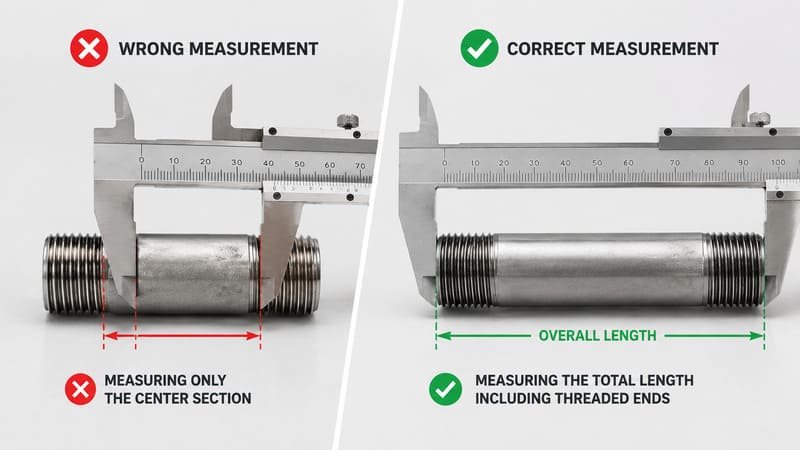
Overall Length
Overall length is the total physical length of the pipe nipple measured from one end to the other.
It includes:
- Threaded sections
- Unthreaded center section
- Entire pipe body
For many standard pipe nipples, overall length is the most common measurement used in product specifications.
Example:
Thread Length
Thread length refers to the length of the threaded section on each end of the pipe nipple.
Thread length affects:
- Connection depth
- Thread engagement
- Sealing performance
Insufficient thread length may result in weak connections, while excessive thread engagement may cause installation issues.
Effective Length
Effective length refers to the usable connection distance after the pipe nipple is installed between fittings.
This measurement is especially important when calculating the final position of connected components.
How to Measure a Standard Barrel Nipple
A barrel nipple usually has threaded ends and an unthreaded center section.
The measurement process is:
Step 1: Place the Pipe Nipple on a Flat Surface
Make sure the nipple is straight and not installed into any fittings.
Step 2: Measure From End to End
Use a measuring tool to measure the complete length.
This measurement represents the overall length.
Step 3: Record Thread Length
Measure the threaded section on both ends separately.
This information is useful when thread engagement is important.
How to Measure a Close Nipple
Close nipples are different because the threads extend almost across the entire nipple length.
When measuring a close nipple:
- Measure the total end-to-end length
- Confirm thread type
- Confirm thread engagement requirements
Because there is almost no center section, close nipples are usually specified mainly by overall length and thread standard.
Pipe Nipple Length Chart
Common pipe nipple lengths vary depending on application requirements.
Standard lengths may vary between manufacturers and markets.
Factors That Affect Pipe Nipple Length Selection
Choosing the correct pipe nipple length depends on several factors.
Installation Space
Limited installation space often requires shorter nipples.
Examples:
- Valve connections
- Compact equipment
- Small piping systems
Close nipples are commonly used in these situations.
Connection Distance
Longer pipe nipples may be required when components are separated by a larger distance.
Barrel nipples provide more flexibility because they are available in many lengths.
Thread Engagement Requirements
The selected nipple length must provide enough thread engagement with connected fittings.
Incorrect thread engagement may cause:
- Leakage
- Loose connections
- Reduced system reliability
Application Environment
Different industries may require different nipple lengths.
Examples:
Plumbing Systems
Usually require standard lengths for easy installation.
Industrial Equipment
May require customized lengths according to equipment design.
Oil and Gas Applications
Often require strict dimensional control.
Pipe Nipple Length Standards
Professional pipe nipple manufacturers usually follow recognized industry standards.
Common standards include:
- ASTM A733
- ASME B1.20.1
- Customer-specific drawings and specifications
These standards help ensure:
- Correct dimensions
- Thread accuracy
- Product compatibility
Common Mistakes When Measuring Pipe Nipples
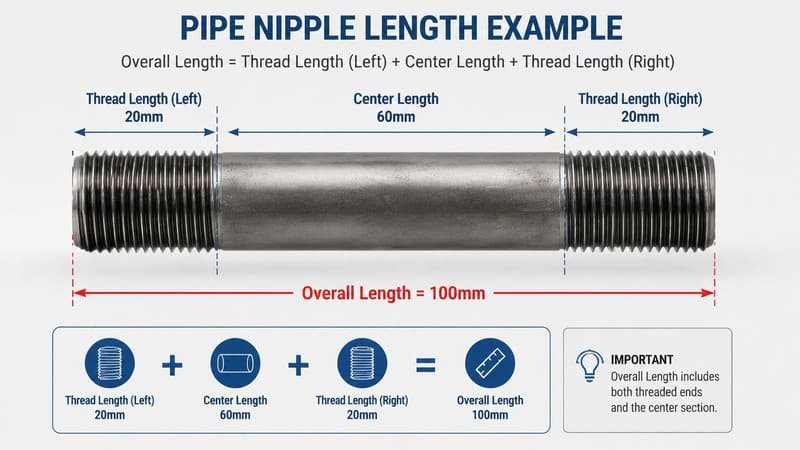
Measuring Only the Unthreaded Section
Some buyers measure only the center pipe section and ignore the threaded ends.
This can result in ordering an incorrect length.
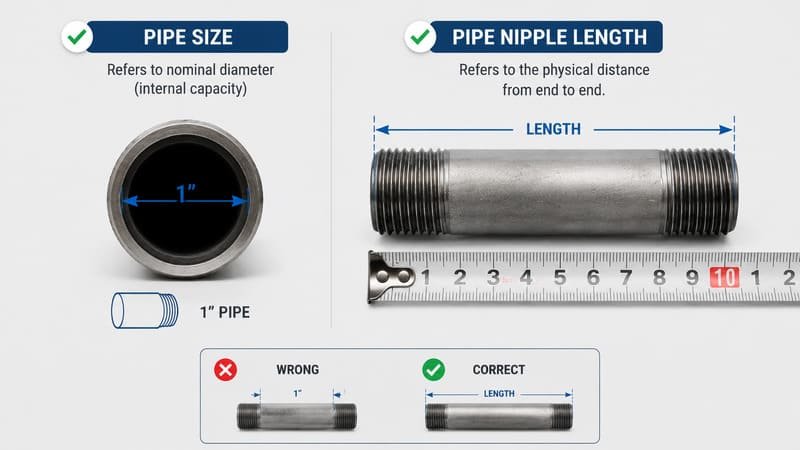
Confusing Pipe Size With Nipple Length
Pipe size refers to nominal diameter.
Pipe nipple length refers to the physical distance from end to end.
These are two different specifications.
Ignoring Thread Standard
A correct length with the wrong thread type may still fail during installation.
Always confirm:
- NPT
- BSP
- BSPT
before ordering.
Custom Pipe Nipple Length Manufacturing
Many industrial applications require custom pipe nipple dimensions.
Professional manufacturers can provide:
- Custom lengths
- Custom thread types
- Custom materials
- Special requirements
Common customized options include:
- Stainless steel pipe nipples
- Carbon steel pipe nipples
- Galvanized pipe nipples
- Brass pipe nipples
Frequently Asked Questions
How do you measure a pipe nipple length?
Pipe nipple length is usually measured from one end to the other, including threaded sections. This measurement is called the overall length.
Does pipe nipple length include threads?
Yes. In most cases, overall pipe nipple length includes both threaded sections and the center pipe section.
What is the difference between pipe size and pipe nipple length?
Pipe size refers to the nominal diameter, while pipe nipple length refers to the physical length of the nipple.
Can pipe nipples be made in custom lengths?
Yes. Manufacturers can produce custom pipe nipples according to customer drawings, specifications, and application requirements.
Conclusion
Correctly measuring pipe nipple length is essential for ensuring proper installation and reliable piping connections.
When selecting a pipe nipple, always consider:
- Overall length
- Thread length
- Thread standard
- Material
- Application requirements
Whether you need standard or custom pipe nipples, working with an experienced manufacturer helps ensure accurate dimensions and dependable performance.