Step 1: Measure and Match Your Existing Pipe
Measure your pipe or fitting sizes before placing a bulk order for pipe nipples. This step is a common cause of incorrect installations.
1. Conform the NPS, not OD
Pipe sizing is based on nominal size. A 1-inch pipe does not measure exactly 1 inch on the outside or inside — this is the most confusing point for buyers.
2. Measuring OD
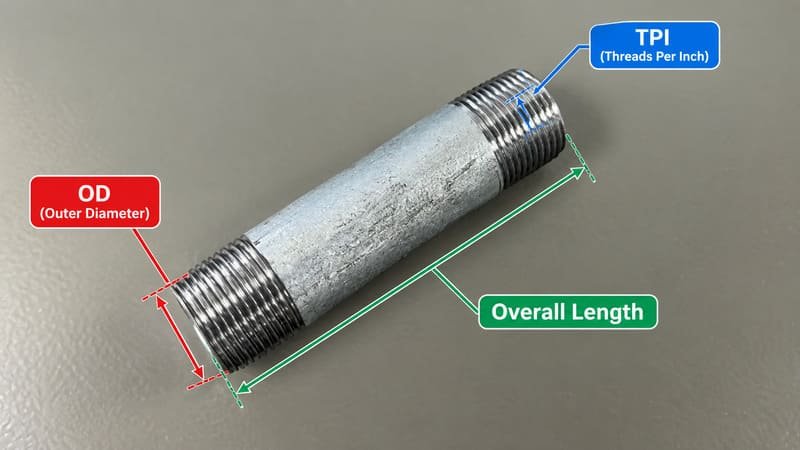
- Wrap a string around the pipe, measure the circumference, then divide by π (3.14) to get the OD.
- Or use calipers directly across the widest point of the pipe end.
- Cross-reference the OD against a standard NPS chart to identify the nominal size.
3. Check the thread type and count (TPI)
- Count the number of threads per inch (TPI) using a thread gauge or ruler.
- Confirm whether the thread is NPT (National Pipe Thread, tapered) or straight-thread—this affects sealing and compatibility.
4. Measure required overall length
- Measure the gap between the two fittings you need to connect.
- Account for how far the nipple threads into each fitting (typically the thread engages a few full turns, not the entire threaded length)
Common Measurement Error and Consequence
| Error | Consequence |
|---|---|
| Measuring ID instead of NP | Ordered pipe nipples are too large or too small and cannot insert the connector. |
| Confuse NPT and straight threaded (such as NPS or BSP)) | Leakage at the interface, or unable to spin it. |
| Ignore the depth of the threaded insert when measuring | Pipe nipple too short or too long. |
| Measuring OD with tape instead of a caliper | Inaccurate, especially for Schedule 80/160 thicker-wall pipes |
| Believed all 1-inch pipe nipples can be changed | Mixing different threaded standard pipe nipples causes seal failure at high pressure. |
Step 2: Confirm the Thread Standard
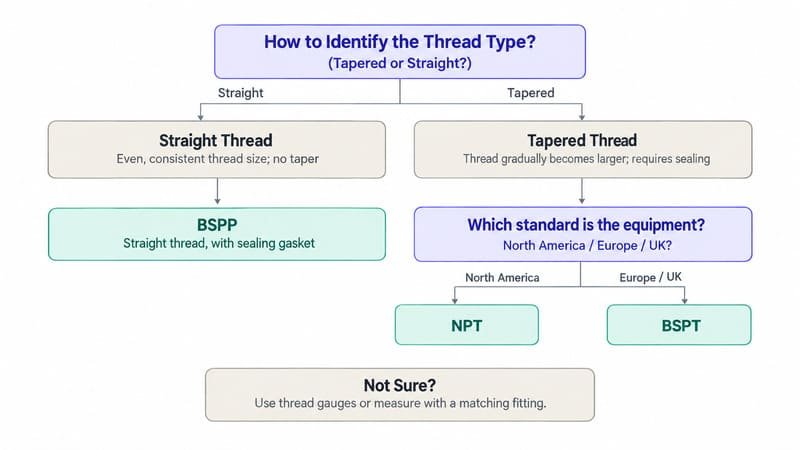
1. Look at threaded shapes: Tapered or Straight
- If you touch the thread around it and it gradually becomes thinner (like a cone), it is a conical thread (NPT or BSPT).
- If the entire thread is of uniform thickness, it is a straight thread (BSPP).
2. Look at the Seal Method
- Tapered Threaded (NPT/BSPT): After tightening, the threads themselves squeeze and seal each other; usually requires thread sealant tape.
- Straight Threaded (BSPP): The thread itself is not sealed and requires additional rubber gaskets or O-rings to prevent leakage.
3. Look at the original equipment
- American, Canada, and North America → Mostly NPT
- Europe, UK, Australia → mostly BSPT or BSPP.
- If the old device manual has G (for example, G1/2), it is basically BSPP. Writing R or PT usually indicates BSPT.
Step 3: Match the Pressure and Temperature Requirement
1. Household Water Supply
- Typical working pressure: 40-80 PSI
- Temperature range: normal to about 60°C
- Suggested Grade: Schedule 40 galvanized steel pipe nipple or brass pipe nipple can meet the requirement.
2. Industrial Pipeline
- Typical working pressure: 150-300 PSI
- Temperature range: Depends on the medium; commonly -20°C to 150°C.
- Suggested Grade: Schedule 80 carbon steel or stainless steel pipe nipple. For high-pressure hydraulic systems, confirm the rated burst pressure rather than looking at the Schedule grade.
3. Gas Pipeline
- Typical working pressure: Commonly lower
- Temperature range: Normal is mainly, but consider outdoor temperature differences.
- Suggested Grade: Use materials specifically certified for gas (such as black steel pipe nipple to avoid corrosion in certain gas environments), and comply with local gas standards (such as ANSI Z21 or local pipeline regulations). This cannot be replaced with pressure grades and must be verified and certified.
4. High-temperature Steam
- Typical working pressure: More than 300 PSI; temperature can be around 200°C+
- Suggested Grade: Schedule 160 stainless steel pipe nipple; confirm the material’s corrosion resistance performance (Whether in contact with acidic or alkaline media).
| Applications | Typical Pressure Range | Recommended Materials | Recommended Schedule | Note |
|---|---|---|---|---|
| Household / Civil Water Pipe | 40-80 PSI | Galvanized Steel / Brass | Schedule 40 | For hot water pipes, avoid carbon steel to prevent corrosion. |
| HVAC | 80-150 PSI | Black Steel / Galvanized Steel | Schedule 40 | Pay attention to compatibility with refrigerating fluid. |
| Industrial Compressed Air | 150-300 PSI | Carbon Steel / Stainless Steel 304 | Schedule 80 | Inspect regularly for seal aging. |
| Hydraulic System | 300-1000+ PSI | Stainless Steel 316 | Schedule 80 and above | Verify rated burst pressure, not just the schedule. |
| Gas line (Civil / Industrial) | 0.5-7 PSI (Civil) | Black Steel | Schedule 40 | Comply with local gas specifications; galvanized steel pipes are prohibited. |
| High-temperature steam / Chemical Medium | 300+ PSI, 200°C+ | Stainless Steel 316 | Schedule 160 | Confirm the medium’s corrosivity; choose the anti-corrosion material. |
| Marine / High Salt Corrosive Environment | Depends on the Applications | Stainless Steel 316L | Schedule 80 and above | 316 is better than 304 for chloride ion corrosion resistance. |
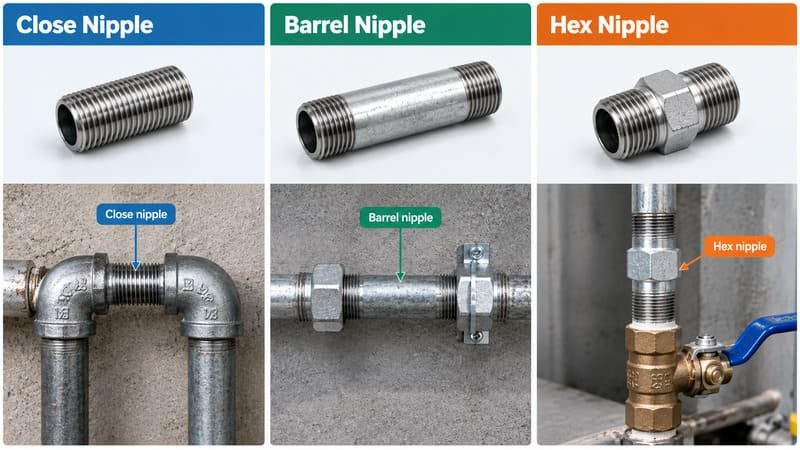
Step 4: Installation Space Limitation
1. Renovate the pipe connectors in the narrow space within the wall
In a renovation of an old house, a plumber needs to connect 2 ball valves within the wall, with only about 3 cm of space. The space cannot accommodate a pipe nipple.
→ In this situation, a close pipe nipple must be used. Its length meets the depth of the threaded insert; the middle part has no bare pipe body. It is the only option to resolve a zero-clearance connection.
The trade-off: the threaded root of a close pipe nipple is more prone to fatigue cracking over time and is removed frequently because it has no body to buffer.
2. Bridging a longer gap between equipment in a mechanical room
In a factory equipment room, you need a pipe nipple to connect 2 pieces of equipment.
→ In this situation, a barrel nipple is suitable to be used across this space without an extra short pipe and 2 pipe connectors; this can reduce a potential leak point.
Tip: Barrel nipple lengths are customized or standard; measure the space between the two pipe connectors before ordering; do not estimate.
3. A connection point that needs frequent disassembly for maintenance
A compressed air pipeline in a factory equipment room has a port that needs scheduled maintenance; workers report that the wrench is difficult to clamp onto the round-shaped barrel pipe nipple and apply force to twist in the narrow space.
→ In this situation, a hex nipple is just right: use the wrench to bite and exert force to avoid slipping, suitable for where it is frequently removed and installed, or where the installation space is narrow and the wrench cannot be forced in easily.
Notice: The hex section of a hex nipple is usually slightly thicker than a same-size barrel nipple. If installation space is limited, confirm in advance whether the width of the hex opposite side will fit.
Conclusion
Go through these 4 steps: measure and match, threaded standard, pressure and temperature, installation space. Now you should clearly know what pipe nipple standards you need: sizes, threaded types, materials, schedule grade, and installation methods.
But knowing what to buy and how to buy are 2 different things. Especially when buying in bulk, it also involves MOQ, lead time, certificates, and customized sizes a series of questions. We explained this content in detail in the pipe nipple procurement guide.
Next: get a quote.