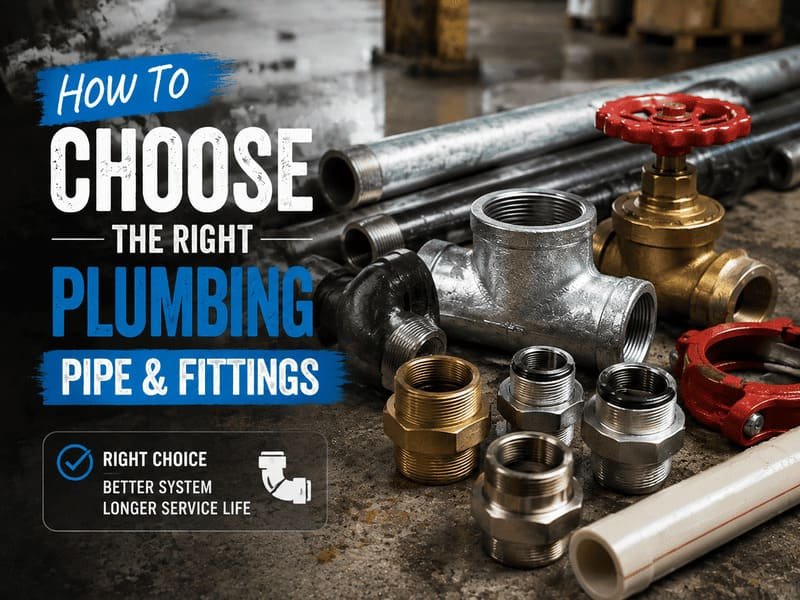
Many customers may be puzzled about how to choose the right plumbing pipes and fittings when purchasing for industrial applications.
Each fitting is suitable for different applications based on its service conditions, transmission medium, pressure rating, temperature range, and installation method.
Selecting pipe fittings is not only about considering the same pipe diameter. The fittings need to match the entire piping system.
You need to consider the material, connection type, pressure rating, temperature, and medium corrosiveness when selecting products.
We will discuss several common industrial pipe systems below and analyze which pipes or fittings are the best choice for different applications.
1. Home and Construction Water Supply System
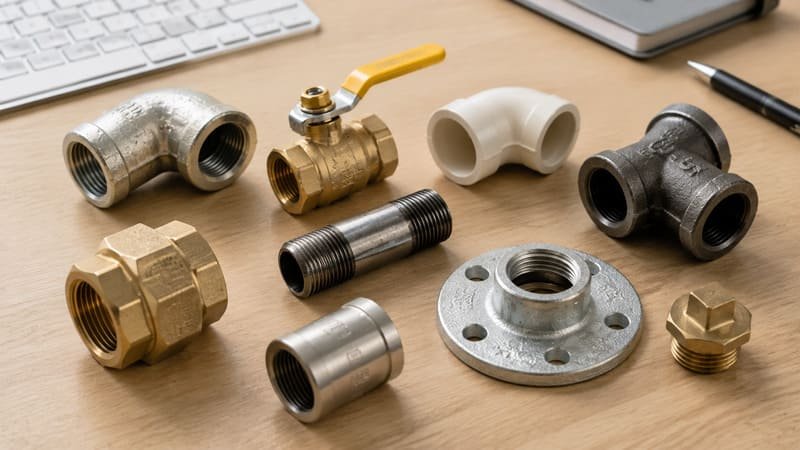
Whether it is cold water plumbing, hot water plumbing, or circulating water systems, they cannot be separated from materials such as galvanized steel, brass, PVC, and CPVC.
Galvanized steel pipe was mainly used in older residential water supply systems but is uncommon in modern residential buildings. When using galvanized steel pipes, hot water systems should generally be avoided.
Brass valves are commonly used as connectors for faucets and water heaters. Their excellent corrosion resistance allows them to be used in both cold and hot water systems. ASTM B43 brass pipe fittings provide excellent corrosion resistance and are widely used in plumbing applications.
PVC pipes and elbows are common in water supply systems. They are usually connected with cement, making them low-cost and lightweight, but they are not suitable for hot water systems or outdoor applications exposed to strong ultraviolet radiation.
CPVC is a modified version of PVC. CPVC pipes can withstand higher temperatures and can be used in hot water systems.
2. Fire Sprinkler System
Fire sprinkler systems cannot operate without galvanized carbon steel and ductile iron materials.
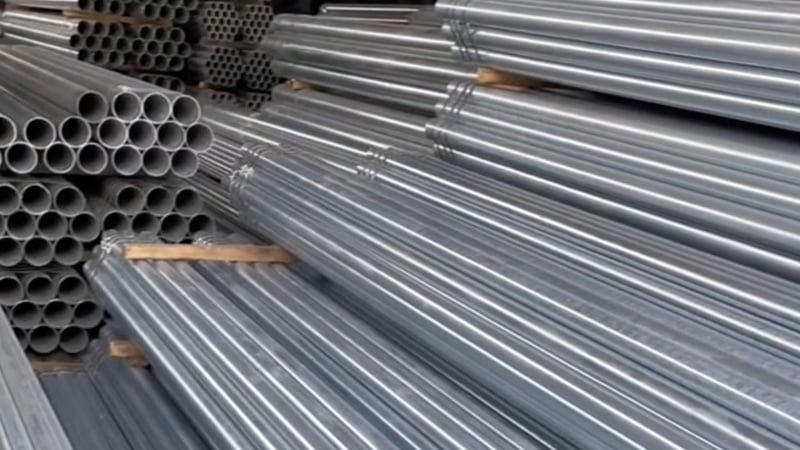
Galvanized carbon steel is a typical material used as fire sprinkler pipe fittings. Pipes and grooved couplings provide high pressure resistance and high mechanical strength, meet fire protection requirements, and are commonly used in indoor fire sprinkler systems, commercial buildings, warehouses, and factories.
The commonly used standards include ASTM A53 and ASTM A795.
Ductile iron is different from galvanized steel. Ductile iron pipes are usually used for underground fire water supply systems and municipal fire protection systems. They have a long service life, excellent corrosion resistance, and are suitable for underground installation.
Regardless of which material is selected, thicker wall thickness should be considered first in fire protection piping systems.
3. Compressed Air System
Aluminum, stainless steel, and galvanized steel are all common materials used in compressed air systems, but they have different applications.
Aluminum pipes are lightweight, rust-resistant, have smooth inner walls, and allow fast installation.
Stainless steel pipes provide excellent corrosion resistance and prevent contamination of compressed air.
Galvanized steel pipes provide high strength and lower cost, but corrosion may occur after long-term use.
4. Petroleum, Natural Gas, and Industrial Pressure Pipeline
These environments have high requirements for pipe and fitting materials. The piping systems need to provide safe operation for decades, withstand high pressure and high temperatures, and resist corrosion.
When purchasing products for these applications, customers pay more attention to material grades, standards, reliability, and long-term performance than to price alone.
Carbon steel has the largest volume of use in oil and gas pipe fittings. ASTM A106 and API 5L carbon steel pipes are suitable for different piping applications.
Carbon steel provides lower cost, high strength, and excellent welding performance, but corrosion protection is an important consideration for long-term service. Corrosion-resistant coatings are often required.
Stainless steel is more commonly used in offshore platforms and other harsh environments because it can resist chloride ion corrosion.
Butt weld fittings are usually used in large diameter and high flow applications, while forged fittings are suitable for smaller diameter and higher pressure applications.
5. Chemical Pipeline
Chemical pipe fittings transport acids, alkalis, and corrosive liquids, so stainless steel is usually the first choice.
316 stainless steel has better corrosion resistance than 304 stainless steel and is more suitable for chemical applications.
Chemical pipelines are more suitable for welded pipe fittings because they can reduce leakage risks and avoid residual medium inside the pipeline.
Stainless steel pipes are recommended to be polished before use. Polishing can remove iron contamination and oxide layers from the surface.
ASTM A182 is a standard for forged pipe fittings and is suitable for high-pressure applications.
6. Food, Beverage, and Pharmaceutical Industry
These industries attach great importance to safety. Safe operation, easy cleaning, and pollution-free performance are the general requirements.
Stainless steel is the preferred material because it provides excellent corrosion resistance, smooth surfaces, and better hygiene performance.
7. Steam System
Carbon steel and stainless steel are both suitable for steam systems because of their ability to withstand high temperatures and pressure, temperature variations, and thermal expansion.
The key factors for selecting pipe fittings for steam systems are not only corrosion resistance. More importantly, fittings need to withstand high pressure, high temperatures, temperature changes, and thermal expansion conditions.