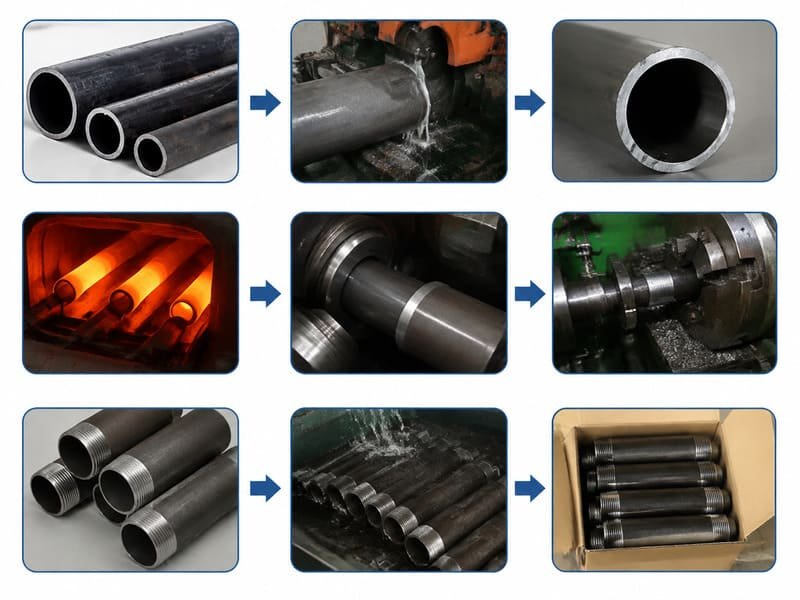
We are a pipe nipple manufacturer in Cangzhou, Hebei, China, supplying importers and distributors. Below, we explain how we make pipe nipples, from material checks to export packing, and how welded and seamless nipples differ.
Pipe nipples are classified as welded or seamless based on the raw material used. With our pipe nipple production experience, we select pipes based on application requirements. However, the processing steps are not very different. The biggest differences are raw material selection and the final step — quality inspection.
In actual production, selecting steel pipes is the first and most important step. Different applications require different pipe materials, standards, and manufacturing methods.
For welded nipples, the final inspection checks the quality of the weld seam and threads. For seamless nipples, inspection focuses on material, wall thickness, and thread quality.
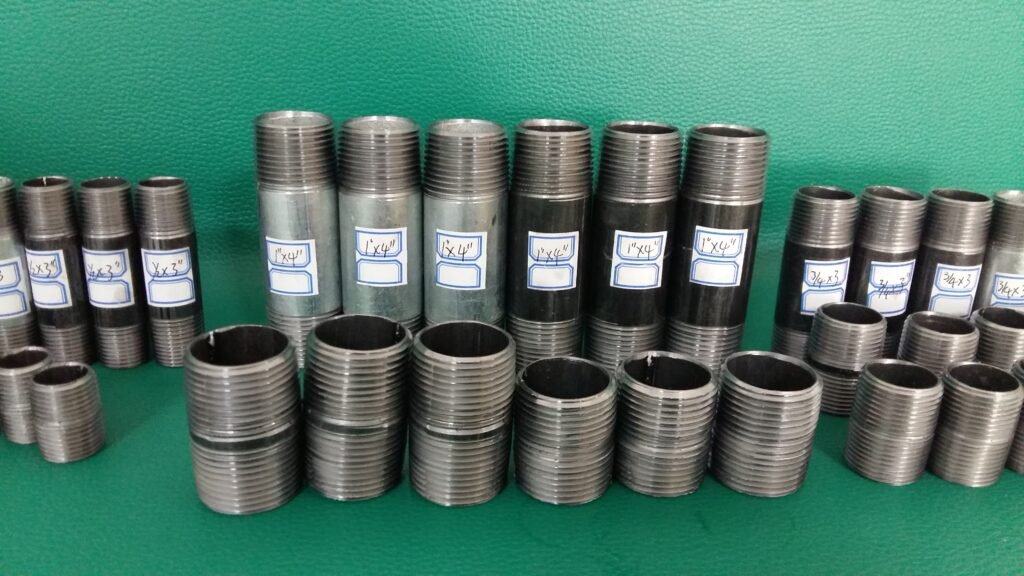
Welded vs Seamless Pipe Nipples
| Item | Welded Nipple | Seamless Nipple |
|---|---|---|
| Raw material | ERW welded pipe | Seamless steel pipe |
| Main advantage | Cost-effective | No weld seam; preferred for high-pressure or high-temperature service |
| Inspection focus | Weld seam quality | Material performance |
| Common applications | General piping | High-pressure systems |
How Pipe Nipples Are Made, Step by Step
Step 1: Raw Material Selection
Steel pipes are used as the raw materials for pipe nipples. Only pipes that meet the required standards can be manufactured into pipe nipples. Steel pipes are usually checked for material grade, OD, wall thickness, and surface.
Taking American standards as an example:
Carbon steel standards: ASTM A53 (seamless or ERW), ASTM A106 (seamless), API 5L.
Stainless steel standard: ASTM A312.
We verify material certificates and check chemical composition and mechanical properties before production.
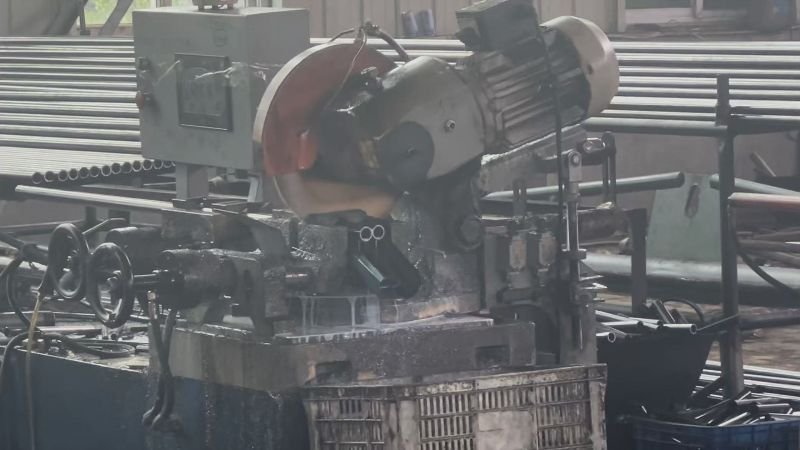
Step 2: Pipe Cutting
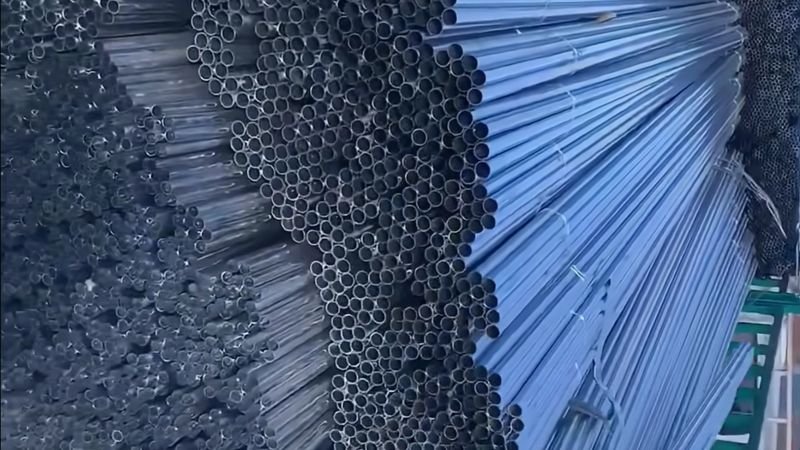
Usually, raw pipes are cut to produce pipe nipples of different sizes.
Common raw steel pipe lengths are 6 m- 12 m. Pipes are cut into the required lengths, and one steel pipe can be cut into many pipe nipples.
Pipe nipples usually range from 1-1/2 to 8 inches in length, and longer lengths can be customized.
Step 3: Facing & Deburring
Steel pipes may have burrs or uneven edges after cutting. Correcting them ensures thread quality, safe installation, and smooth flow.
Proper facing and deburring ensure accurate threading and reduce the risk of leakage caused by poor connections.
Step 4: Chamfering
The outer side of the pipe opening is chamfered to facilitate threading and protect the thread entry. The common angle is between 30 and 45 degrees.
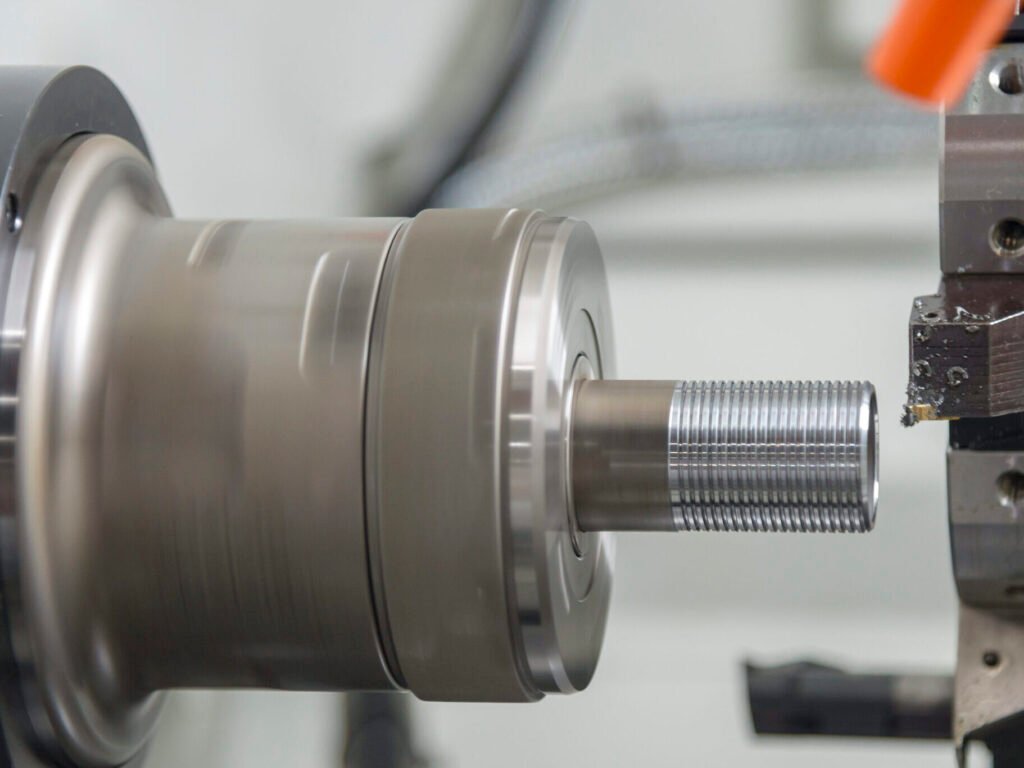
Step 5: Threading
Threading is a core step in manufacturing pipe nipples. North American threaded standards include NPT (ASME B1.20.1).
The European market can choose BSPT (ISO 7-1 / EN 10226-1) and BSPP (ISO 228-1).
Processing methods are divided into cutting threads and rolling threads. During threading, the thread profile, pitch accuracy, and thread length are controlled carefully. Thread gauges are commonly used to verify thread quality and ensure proper connection.
Step 6: Cleaning
This step removes impurities that accumulate during machining, preparing the surface for treatment.
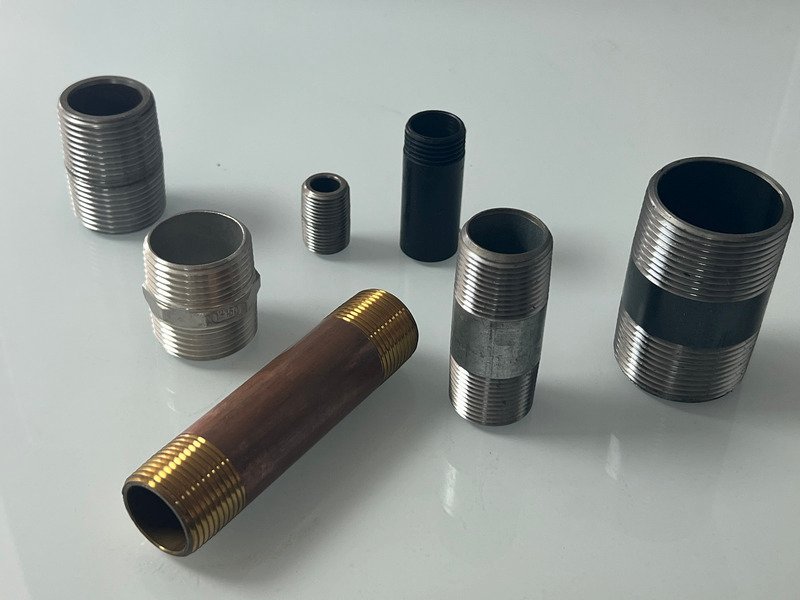
Step 7: Surface Treatment
Black steel pipe nipples enhance corrosion resistance with black anti-rust oil.
Galvanized steel nipples need a zinc coating to prevent corrosion. The coating processes are electro-galvanizing and hot-dip galvanizing.
Stainless steel pipe nipples in exposed environments can be polished to look brighter and more beautiful.
Step 8: Quality Inspection
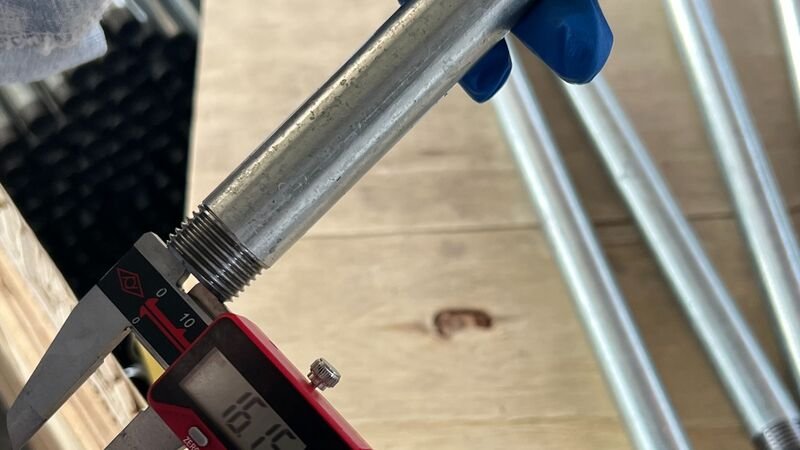
Our inspections include dimensions, thread gauge, surface, and material against customer requirements and applicable standards.
For welded pipe nipples, attention is paid to weld seam quality. For seamless pipe nipples, inspection focuses on material, wall thickness consistency, and performance.
Step 9: Packaging
We offer two types of packaging: carton boxes and pallets. Small quantities are packed in cartons, while large volumes are packed on pallets.
Thread protectors or proper packing methods are used when necessary to prevent thread damage during transportation.
Finally, we mark each pipe nipple with:
- Manufacturer logo
- Material grade
- Size or standard
FAQ
Q1: Can you make pipe nipples to my drawing or custom specifications?
Yes. We can produce custom lengths, materials, and thread types: carbon steel, galvanized steel, and 304/316 stainless steel, with NPT, BSPT, or other thread standards. For an accurate quote, send us your drawing or the NPS, wall thickness or schedule, length, thread type, end, surface finish, and quantity. See our Custom Service page for details.
Q2: Which quality documents and inspections come with an order?
We provide the MTC with each shipment. We inspect finished nipples for length, OD, wall thickness, surface, and thread quality using thread gauges. You can review sample MTC certificates and read our quality control process.
Q3:What information do I need to send to get a quote?
Send your drawing or the NPS, wall thickness or schedule, length, thread type, end, surface finish, material standard, quantity, and destination port. We reply within 1 working day.
From raw material selection to final inspection, these steps affect the quality and performance of pipe nipples. Send your drawing or specifications to sales@pipenipples.com, and we will reply within 1 working day.