When we talk about pipe nipple standards, we need to consider the material and threading standards.
Standard System Overview
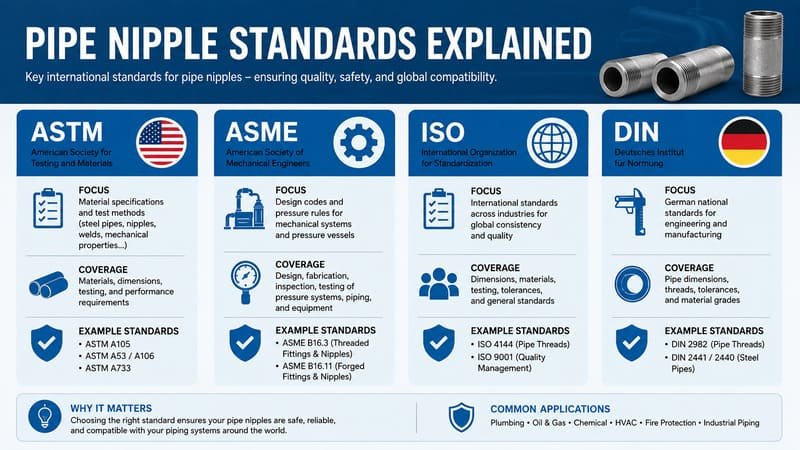
ASTM
It is a common standard for materials, products, and test methods in the American system.
Such as: ASTM A53 steel pipe, ASTM A106 seamless carbon steel pipe, A312 stainless steel pipe.
ASME
ASME = American Society of Mechanical Engineers
Such as: ASME B16.9 – butt welded pipe fittings,
ASME B16.5 – flange,
ASME B16.11 – forged threaded/socket welded pipe fittings,
ASME B16.3 – malleable cast iron threaded pipe fittings
So, ASTM is more often concerned with material and product requirements.
ASME often refers to design dimensions and manufacturing requirements for pipe fittings.
For example, a product can be written as:
Carbon Steel Elbow
Material: ASTM A234 WPB
Dimensions: ASME B16.9
It means:
ASTM A234 WPB: What material is it and what are the material performance requirements
ASME B16.9: What rules are followed for the dimensions, wall thickness, end dimensions, etc.
DIN
It is a standard produced by the German Standardization Association.
Be short: DIN = German standard.
DIN 2982, DIN 2440, DIN 2441, DIN 2999.
Threaded pipe fittings in European marketing are usually DIN.
EN
EN is a European standard; it is by the European Standardization System.
Such as: EN 10241 is a threaded steel pipe fitting standard.
DIN ≠ EN, but German standards can use EN; you may see: DIN EN 10241.
It means EN 10241 has been adopted as a German standard.
ISO
ISO = International Organization for Standardization
Simply put: ISO = International Standard.
ISO standards can be used globally.
BS
BS = British Standard
Released by the British Standards Institution (BSI) system.
For example: BS 21
It is the traditional British standard related to pipe threads.
However, nowadays the UK also widely adopts European standards; you will see:
BS EN 10241
It means: EN 10241 has been adopted by the United Kingdom as a British standard.
Material standards
ASTM A733 Pipe Nipple Standard
ASTM A733 is one of the most commonly referenced standards for pipe nipples.
It covers:
- Carbon steel pipe nipples
- Welded and seamless pipe nipples
Typical requirements include:
- Material quality
- Dimensions
- Thread specifications
- Workmanship
ASTM Material Standards
Depending on the application, pipe nipples may also involve other ASTM material specifications.
Examples:
Carbon steel:
- ASTM A53
- ASTM A106
ASTM A53 is the most common standard.
Stainless steel:
- ASTM A312
ASTM A312; it means these pipes need to meet certain requirements. And note that 304/316 stainless steel are materials, not a standard.
Galvanized carbon steel is not a material; it is a carbon steel material with a zinc coating.
The pipe body meets the ASTM A53 standard. It has either ASTM A123 for hot-galvanizing or ASTM B633 for electro-galvanizing.
These standards define the characteristics of the pipe material before nipple manufacturing.
ASME Thread Standards
For threaded pipe nipples, thread requirements are often related to:
ASME B1.20.1
This standard defines:
- NPT thread dimensions
- Thread form taper requirements
NPT threads are widely used in:
- North America
- Industrial equipment
- Hydraulic systems
Why Thread Standards Matter
Incorrect threads may cause:
- Leakage
- Installation problems
- Connection failure
Before ordering pipe nipples, buyers should confirm:
- Thread type
- Thread size
- Thread standard
DIN Threaded Pipe Nipples
DIN-based pipe nipples are commonly associated with:
- European piping systems
- Industrial equipment
- Mechanical applications
Common thread types include:
- BSP threads
- Metric threads
Comparison of ASTM, ASME and DIN Standards
Standard System | Main Purpose | Common Application |
|---|---|---|
ASTM | Material and product requirements | Steel pipe nipples |
ASME | Engineering and thread standards | Pressure and piping systems |
DIN | European industrial standards | Mechanical and piping applications |
Pipe Nipple Standards and Thread Types
The thread standard is one of the most important specifications.
NPT Thread
Common in:
- USA
- Canada
- North American industrial systems
Features:
- Tapered thread
- Good sealing performance
BSP Thread
Common in:
- Europe
- Asia
- International markets
Types:
- BSPP
- BSPT
Common Mistakes When Selecting Pipe Nipple Standards
Assuming All Pipe Nipples Follow the Same Standard
Different projects may require different specifications.
Ignoring Thread Standards
A product may have the correct size but the wrong thread.
Choosing Material Without Checking Standards
Material requirements should match the working environment.
Frequently Asked Questions
What standard is used for pipe nipples?
ASTM A733 is a commonly referenced pipe nipple standard for carbon steel and alloy steel nipples.
Are ASTM and ASME the same?
No.
ASTM mainly focuses on materials and products, while ASME focuses more on engineering systems and design requirements.
What thread standard is used for pipe nipples?
Common thread standards include NPT, BSP, BSPT, and metric threads.
Can manufacturers produce pipe nipples according to customer standards?
Yes. Professional manufacturers can produce pipe nipples according to different standards, drawings, and project requirements.