As a manufacturer of threaded pipe fittings, I am often asked the same question:
Should I choose threaded pipe fittings or welded fittings?
The answer depends on your operating pressure, installation environment, maintenance requirements, and budget.
Over the years, I have supplied fittings for projects. I want to explain the differences between threaded and welded fittings and help you choose the right solution.
What Are Threaded Pipe Fittings?
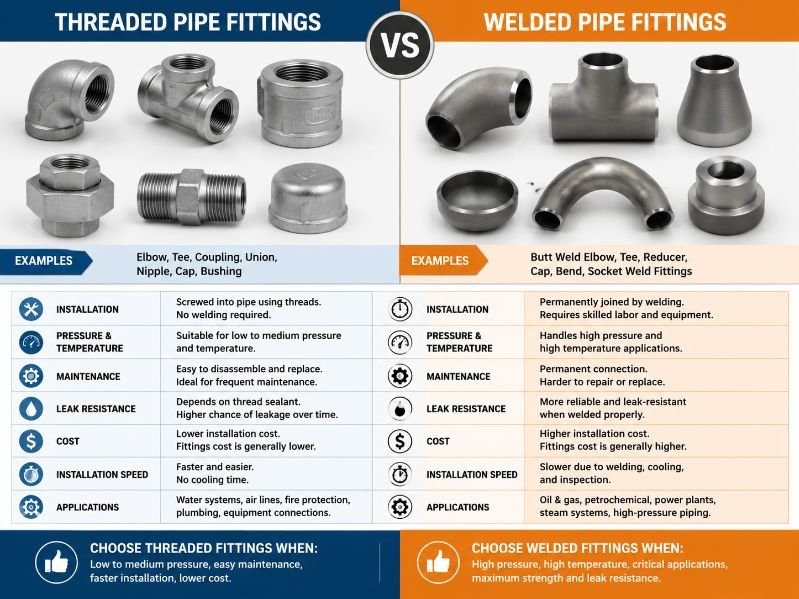
Threaded pipe fittings connect pipes using male and female threads. Common examples include:
- Pipe nipples
- Couplings
- Elbows
- Tees
- Unions
- Bushings
The most common thread standards are:
- NPT (National Pipe Thread)
- BSPT (British Standard Pipe Taper)
- BSPP (British Standard Pipe Parallel)
Installation requires no welding equipment. The fitting is simply screwed onto the pipe and tightened to create a seal.
Threaded fittings are widely used in small- and medium-diameter piping systems.
What Are Welded Fittings?
Welded fittings are permanently joined to the pipe through welding.
Common welded fittings include:
- Butt weld elbows
- Butt weld tees
- Reducers
- Caps
- Socket weld fittings
Welded joints create a continuous metal structure between the pipe and fitting.
This type of connection is preferred in high-pressure, high-temperature, or critical industrial applications.
Threaded Pipe Fittings vs Welded Fittings: Key Differences
1. Installation Cost
One of the biggest advantages of threaded fittings is lower installation cost.
For threaded systems, workers only need basic tools such as:
- Pipe wrenches
- Thread sealant
- PTFE tape
No certified welders or welding equipment are required.
In contrast, welded systems often require:
- Skilled welders
- Welding machines
- Inspection procedures
- Additional labor hours
For smaller projects, threaded fittings can significantly reduce overall installation expenses.
2. Pressure and Temperature Performance
Welded fittings provide higher mechanical strength.
Because the connection becomes a permanent part, welded joints can withstand:
- Higher operating pressures
- Higher temperatures
- Greater vibration loads
For steam lines and petrochemical plants, welded fittings are often the preferred choice.
3. Maintenance and Replacement
This is where threaded fittings offer a major advantage.
If a valve, coupling, or nipple is damaged, it can often be easily removed and the component replaced.
Maintenance teams choose threaded systems because repairs are faster and less expensive.
Welded systems usually require:
- Cutting the pipe
- Grinding welds
- Rewelding replacement components
This increases downtime and maintenance costs.
4. Leak Resistance
A properly executed weld can create an extremely reliable and leak-resistant connection.
Although thread sealants provide excellent sealing performance, they still contain more potential leak paths; welded fittings are generally considered safer.
5. Installation Speed
When project schedules are tight, threaded fittings often save considerable time.
A threaded connection can be completed within minutes.
Welded systems require:
- Surface preparation
- Welding
- Cooling
- Inspection
The speed advantage of threaded fittings reduces labor costs and meets deadlines.
Typical Applications for Threaded Pipe Fittings
In my experience, threaded fittings are commonly used for:
Fire Protection Systems
Threaded pipe nipples and couplings are easy to assemble and maintain.
Compressed Air Systems
Many manufacturing facilities use threaded fittings for air distribution networks.
Water Distribution
Commercial buildings frequently use threaded connections for plumbing and utility piping.
Equipment Connections
Pumps, valves, gauges, and instrumentation often utilize threaded fittings for easier replacement.
Typical Applications for Welded Fittings
Welded fittings are commonly selected for:
Oil and Gas Facilities
High pressure and demanding operating conditions require strong, permanent connections.
Petrochemical Plants
Chemical processing systems often rely on welded joints to minimize leakage risks.
Steam Systems
High-temperature steam lines are generally welded rather than threaded.
Power Generation Facilities
Critical piping systems require maximum structural integrity and reliability.
How I Recommend Choosing Between Them
When customers ask me which option is better, I usually provide the following guideline:
Choose threaded pipe fittings if:
- Pipe sizes are generally 4 inches or below
- Easy maintenance is important
- Installation speed matters
- Budget is a concern
- Operating pressure is moderate
Choose welded fittings if:
- The system operates under high pressure
- Temperatures are elevated
- Leakage risks must be minimized
- Long-term structural strength is critical
- The application involves hazardous fluids or gases
My Final Thoughts
Learned the benefits of threaded and welded fittings in different applications before use.
Threaded fittings offer lower installation costs, faster assembly, and easier maintenance.
Welded fittings provide greater strength, higher pressure capability, and superior long-term leak resistance.
The best choice depends on your specific operating conditions and project requirements.
Before purchasing, evaluate pressure ratings, temperature ranges, maintenance expectations, and applicable industry standards. Selecting the correct fitting type can improve safety, reliability, and cost.