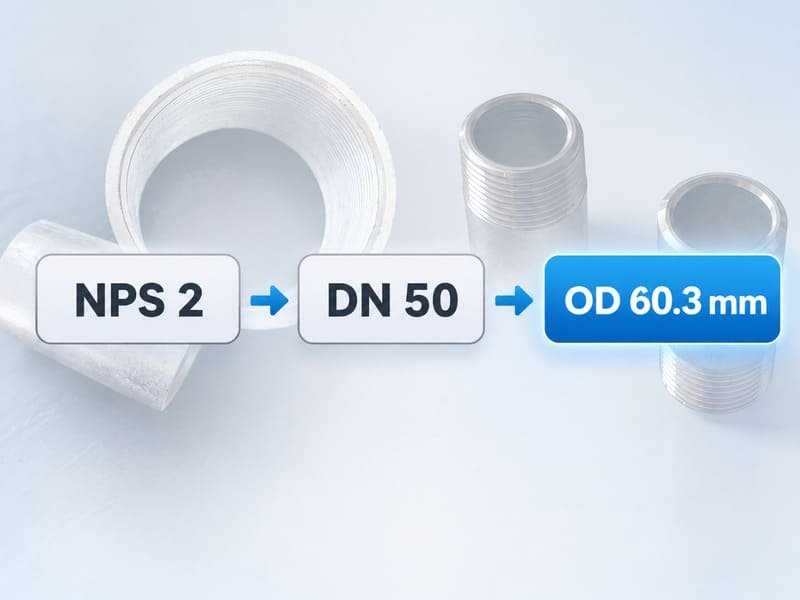
A buyer in Europe sends a drawing marked DN50. A buyer in the United States asks for “2-inch” nipples. A third buyer measures the pipe with calipers and gets 60.3 mm. All three are talking about the same pipe, yet none of the numbers match.
This is the most common source of sizing confusion in the pipe fittings trade. NPS, DN, and OD describe pipe size in different ways, and only one of them is an actual measurement.
This guide explains what each term means, gives you a nominal pipe size chart, and shows how to read a size specification.
Here we focus on what causes most ordering errors: converting between pipe sizes.
What Are NPS, DN, and OD?
| Term | Full name | Unit | What it really tells you |
|---|---|---|---|
| NPS | Nominal Pipe Size | Inches | A size label used mainly in North America. It is a name, not a measurement. |
| DN | Diameter Nominal (diamètre nominal) | Millimeters | The metric size label, used in Europe, Asia, and most international projects. Also a name, not a measurement. |
| OD | Outside Diameter | Inches or mm | The real, measurable outer diameter of the pipe. |
What is DN in pipe size? DN (from the French diamètre nominal) is the metric nominal size used in ISO and European standards. It is a rounded reference number, not a measured dimension.
What is NPS in pipe? NPS stands for Nominal Pipe Size, the inch-based system used in North America and defined in ASME B36.10M and B36.19M. Like DN, it names a size and does not equal any measured diameter.
The key point: NPS and DN are labels. OD is the dimension. When two pipes or fittings connect, the OD and the thread end have to match.
DN is roughly 25 times the NPS number, rounded to a standard value. For example, NPS 1 is DN 25, NPS 2 is DN 50, and NPS 6 is DN 150. A few sizes are rounded differently, such as NPS 1-1/4 (DN 32), NPS 1-1/2 (DN 40), and NPS 2-1/2 (DN 65). That is why the pipe size chart below is more reliable than doing the multiplication in your head.
Pipe Size Conversion Chart: NPS, DN and OD
Use this chart to move between inches, metric, and actual outside diameter. OD values follow ASME B36.10M and B36.19M, and DN values follow ISO 6708.
| NPS (inch) | DN (mm) | OD (inch) | OD (mm) |
|---|---|---|---|
| 1/8 | 6 | 0.405 | 10.3 |
| 1/4 | 8 | 0.540 | 13.7 |
| 3/8 | 10 | 0.675 | 17.1 |
| 1/2 | 15 | 0.840 | 21.3 |
| 3/4 | 20 | 1.050 | 26.7 |
| 1 | 25 | 1.315 | 33.4 |
| 1-1/4 | 32 | 1.660 | 42.2 |
| 1-1/2 | 40 | 1.900 | 48.3 |
| 2 | 50 | 2.375 | 60.3 |
| 2-1/2 | 65 | 2.875 | 73.0 |
| 3 | 80 | 3.500 | 88.9 |
| 3-1/2 | 90 | 4.000 | 101.6 |
| 4 | 100 | 4.500 | 114.3 |
| 5 | 125 | 5.563 | 141.3 |
| 6 | 150 | 6.625 | 168.3 |
| 8 | 200 | 8.625 | 219.1 |
| 10 | 250 | 10.750 | 273.1 |
| 12 | 300 | 12.750 | 323.9 |
| 14 | 350 | 14.000 | 355.6 |
| 16 | 400 | 16.000 | 406.4 |
| 18 | 450 | 18.000 | 457.2 |
| 20 | 500 | 20.000 | 508.0 |
| 24 | 600 | 24.000 | 609.6 |
Metric values are rounded to 0.1 mm. Always confirm the exact figure against the standard that applies to your project.
Why a “2 Inch” Pipe Does Not Measure 2 Inches?
Buyers will be surprised because small OD sizes don’t match NPS. An NPS 2 pipe has an OD of 2.375 inches. An NPS 1/2 pipe has an OD of 0.840 inches.
The reason is historical. Early pipe sizes were named after the approximate inside pipe diameter. As wall thicknesses changed over time, manufacturers kept the OD fixed so they would always fit together, and the names stayed.
Two rules make the chart easier to remember:
- NPS 12 and smaller: the OD is larger than the NPS number, and each NPS has one fixed OD.
- NPS 14 and larger: the OD equals the NPS number in inches. An NPS 14 pipe has a 14-inch OD, and an NPS 24 pipe has a 24-inch OD.
Wall Thickness Changes the Inside Diameter, Not the OD
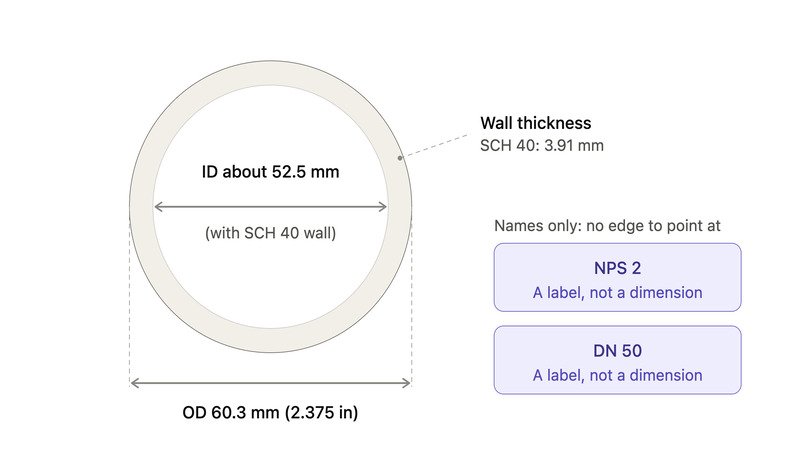
The next question is wall thickness. As covered in our Complete Guide to Pipe Schedules, the schedule number describes wall thickness. The OD stays the same for a given NPS, so a thicker wall consumes the inside material. The inside diameter becomes smaller.
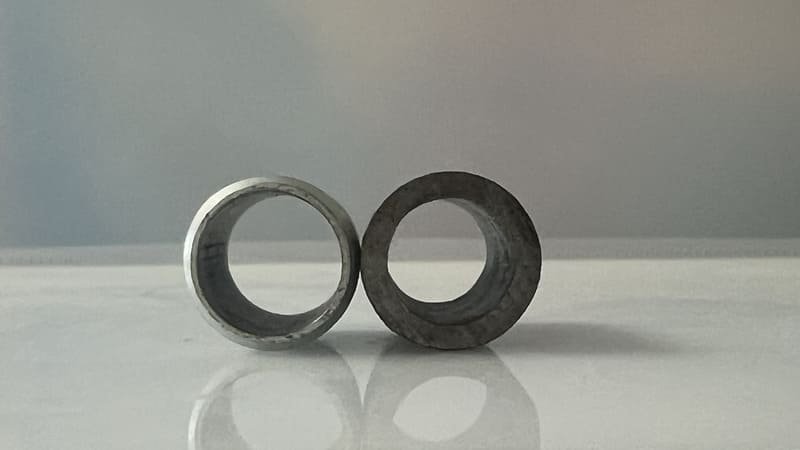
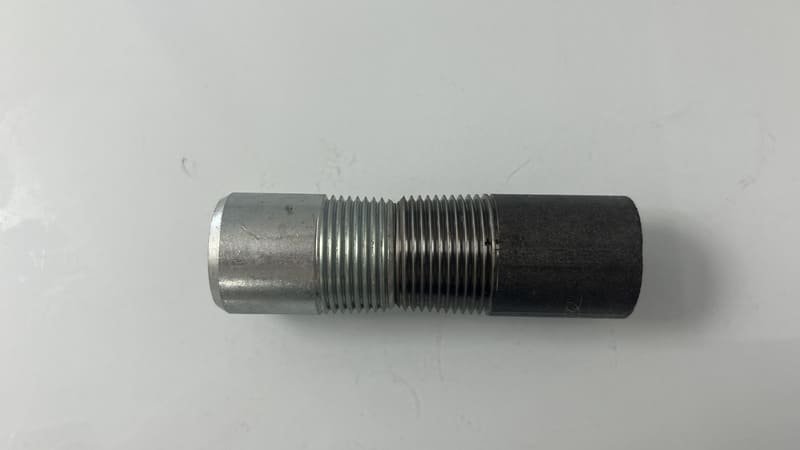
The table below shows the standard wall thickness of SCH 40 and SCH 80 for common sizes, following ASME B36.10M and B36.19M.
| NPS (inch) | DN (mm) | OD (mm) | SCH 40 wall (mm) | SCH 80 wall (mm) |
|---|---|---|---|---|
| 1/8 | 6 | 10.3 | 1.73 | 2.41 |
| 1/4 | 8 | 13.7 | 2.24 | 3.02 |
| 3/8 | 10 | 17.1 | 2.31 | 3.20 |
| 1/2 | 15 | 21.3 | 2.77 | 3.73 |
| 3/4 | 20 | 26.7 | 2.87 | 3.91 |
| 1 | 25 | 33.4 | 3.38 | 4.55 |
| 1-1/4 | 32 | 42.2 | 3.56 | 4.85 |
| 1-1/2 | 40 | 48.3 | 3.68 | 5.08 |
| 2 | 50 | 60.3 | 3.91 | 5.54 |
| 2-1/2 | 65 | 73.0 | 5.16 | 7.01 |
| 3 | 80 | 88.9 | 5.49 | 7.62 |
| 4 | 100 | 114.3 | 6.02 | 8.56 |
| 6 | 150 | 168.3 | 7.11 | 10.97 |
Worked example (NPS 2 / DN 50):
- OD = 60.3 mm for every schedule.
- Inside diameter = OD minus twice the wall thickness.
- SCH 40: 60.3 − (2 × 3.91) = about 52.5 mm.
- SCH 80: 60.3 − (2 × 5.54) = about 49.2 mm.
The pipe looks identical from the outside, but the SCH 80 version has a smaller bore and a thicker wall. This is why a size callout that names only NPS or DN is incomplete.
How to Read a Pipe Size Specification: Three Examples
Example 1: A European drawing says DN50. DN50 corresponds to NPS 2, with an OD of 60.3 mm (2.375 inches). If the drawing doesn’t state a schedule, ask for it, because DN50 alone does not tell you the wall thickness.
Example 2: A U.S. purchase order says “1 inch nipple, 6 inch long.” The “1 inch” is the NPS, which corresponds to DN25 and an OD of 33.4 mm. The “6 inch” is the overall length, as explained in our Pipe Nipple Length and Thread Selection Guide.
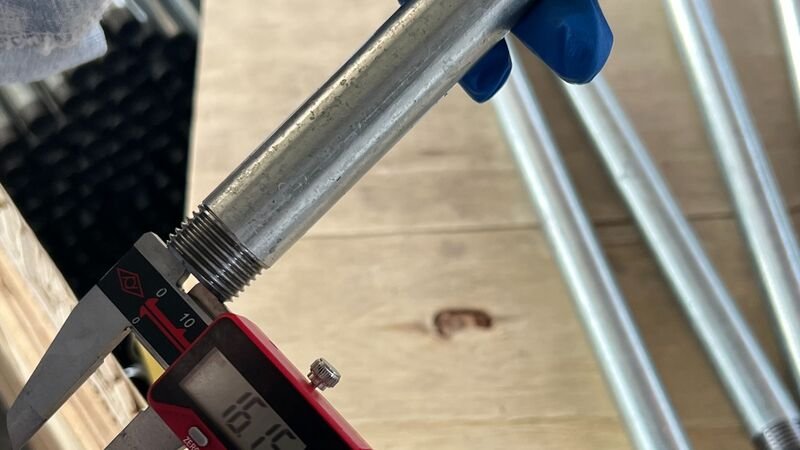
Example 3: A customer measures 48.3 mm with calipers. That is the OD of NPS 1-1/2, equal to DN40. It is not a 48 mm or “2 inch” pipe, even though 48.3 mm is close to 1.9 inches.
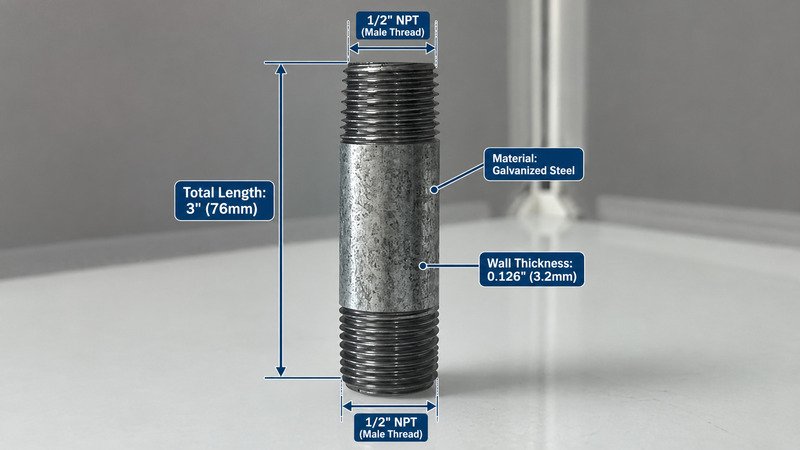
A complete pipe nipple specification should include all of the following:
- Size (NPS or DN)
- Schedule or wall thickness
- Overall length
- Thread type, such as NPT or BSP
- Material and finish, such as carbon steel, stainless steel, black, or galvanized
- Applicable standard, such as ASTM A733
Common Mix-ups
Is NPS the same as NPT? No. NPS here is the nominal pipe size, which describes the pipe. NPT is a thread standard, which describes how the ends are threaded. “NPS” also appears as a straight thread in the ASME B1.20.1 standard, so always check which meaning your drawing uses. For thread comparisons, see our guide to NPT vs BSP threads.
Is DN50 exactly 50 mm? No. DN is a label, and 50 does not measure any actual dimension of the pipe. The real OD of a DN50 pipe is 60.3 mm.
Can I swap a DN pipe for an NPS pipe? In most cases, the OD matches, so the pipe bodies are compatible. Extra care is needed because metric and ASME standards differ slightly in OD or wall thickness, and sizes have different thread types. Confirm the OD and thread before substituting.
Do BSP sizes follow the same naming? BSP threads use the same inch names, so a 1/2 BSP thread and a 1/2 inch NPT thread sound identical. The thread angle and form are different, so they are not interchangeable.
Which one should I put on my purchase order? Write both when you can, for example, “NPS 2 (DN50), SCH 80.” Listing both prevents misunderstandings, and it protects your drawing and the PO.
Quick Checklist Before You Order
- Confirm whether your drawing uses NPS, DN, or an actual measured OD.
- Convert using the chart above, and check the OD in millimeters.
- Confirm the schedule so the wall thickness and inside diameter are clear.
- Confirm the thread type and standard.
- State the overall length, measured end to end.
- Check the applicable standard. For example, the ASTM A733 pipe nipple standard.
Conclusion
NPS and DN are names, and OD is the measurement. Once you know the OD, you can match fittings with confidence, and you can determine the wall thickness and ID after you know the SCH. Keeping this chart on hand and writing both NPS and DN on every order is a simple way to prevent sizing mistakes.
We manufacture pipe nipples and pipe couplings in standard and custom sizes, in carbon steel and stainless steel. Browse our pipe nipples, download dimension sheets from our Documents page, or ask about non-standard lengths through our Custom Service. If you are not sure how to convert your drawing, send us the drawing or size list, and our team will confirm the exact specification before production.