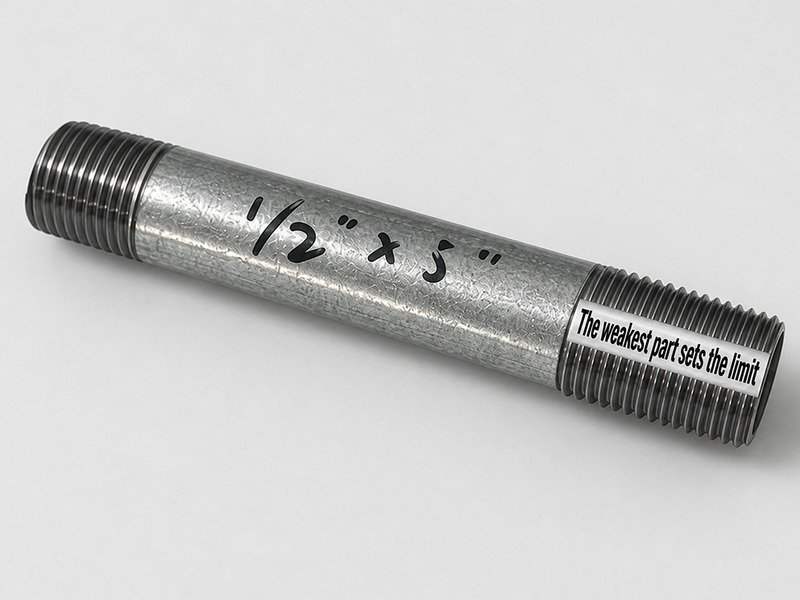
A pipe nipple has no pressure rating marked on it. Working pressure depends on wall thickness, material, operating temperature, and the threaded ends. The weakest one sets the limit for the connection.
Below explains what pressure a pipe nipple can handle, why a threaded nipple is rated lower than pipe of the same schedule, and pipe pressure class. It builds on our Complete Guide to Pipe Schedules and our NPS vs DN vs OD size chart, so reading those will help.
What Decides a Pipe Nipple’s Pressure Rating
| Factor | Why it matters |
|---|---|
| Wall thickness (schedule) | A thicker wall carries more pressure. SCH 80 holds more than SCH 40 at the same size. |
| Material | Carbon steel, stainless steel, and brass have different stresses. |
| Temperature | Allowable stress falls as temperature rises, so the pipe nipple is rated lower when hot. |
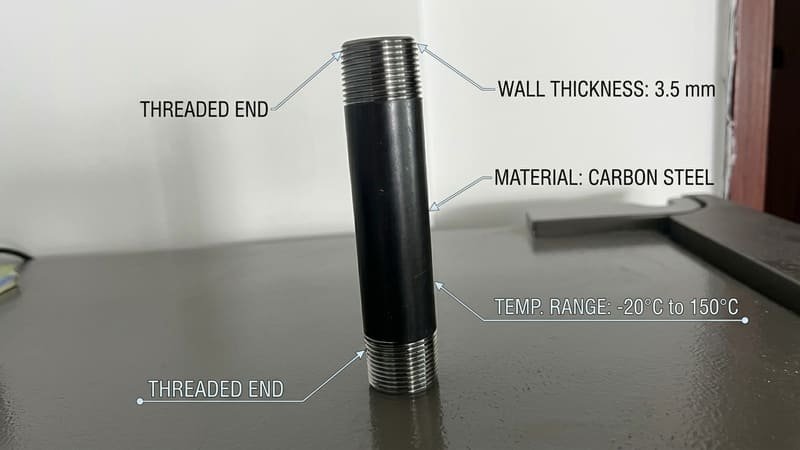
| Threaded ends | Cutting a thread removes wall thickness at the end, usually the weakest section. |
For this reason, the schedule number alone does not give you a pressure rating. The carbon steel pipe nipple at room temperature is very different from stainless steel at 300 degrees C, even in the same SCH 80.
The Basic Formula: How Wall Thickness Becomes Pressure
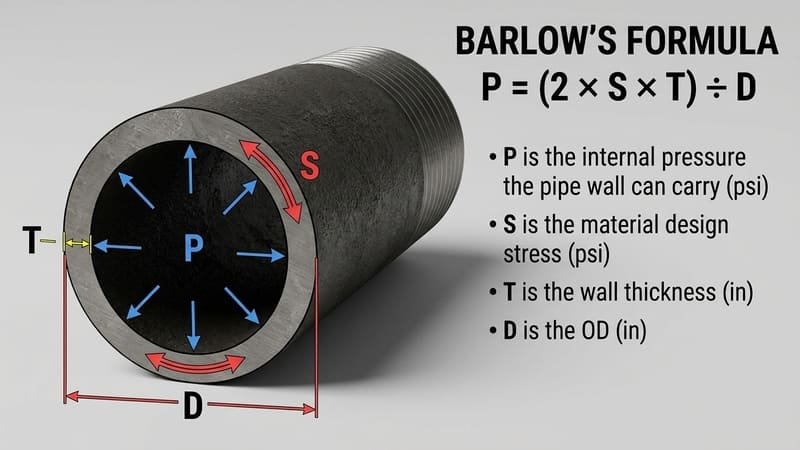
For a quick comparison between schedules, a simplified form of the Barlow formula:
P = (2 × S × T) ÷ D
P is the internal pressure the pipe wall can carry (psi).
S is the material design stress (psi).
T is the wall thickness (in).
D is the OD (in).
This shows why OD matters: for the same wall, a larger diameter means lower pressure. It shows why schedule matters: pressure rises in proportion to wall thickness.
This formula is for comparison only. Real design follows ASME B31.3 or ASME B31.1.
How Schedule Relates to Pressure
A thicker schedule carries more pressure at the same size. SCH 80 has a thicker wall than SCH 40, and SCH 160 is thicker still. Standard pipe can also be up to 12.5% thinner than the nominal wall due to mill tolerance, and the real wall may be slightly thinner.
A pipe nipple pressure rating isn’t based on schedule alone; it also depends on size, material, temperature, and threaded ends.
Why Threaded Ends Lower the Rating
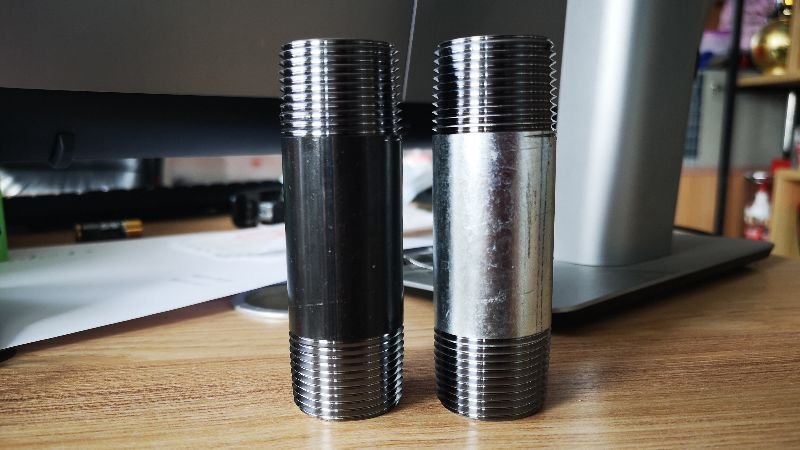
The thread root is the thinnest part of a nipple. It is also where stress concentrates, and where corrosion and wear do the most damage. Three consequences follow:
- The nipple’s weakest point is usually its thread, not its barrel.
- Thin-wall schedules lose a larger share of their wall to the thread than thick-wall ones.
- Over-tightening and poor sealing will make thread problems worse. See our guide on why pipe thread leaks happen.
Class 150 Fittings and Nipples
Class 150 is the pressure class in general threaded fittings. It is a lower-pressure class than the forged classes used in high-pressure service.
A Class 150 rating belongs to the fitting, not to the pipe.
For the couplings that go with these nipples, see our Galvanized Pipe Coupling guide and Black Steel Pipe Coupling guide.
The weakest part sets the limit. If you connect a nipple to a Class 150 fitting, the system is limited by the lower rating. A heavier nipple does not raise the rating of the adjacent fitting, vice versa. Check both against the system’s design pressure.
How Temperature Changes the Rating
Allowable stress falls as temperature rises, so a nipple’s room-temperature rating may not be suitable in a steam line or hot oil.
Take the stress from the standard at actual temperature. Our guides to oil and gas piping systems and chemical plant cooling water systems cover typical service conditions.
How to Choose the Right Pipe Pressure Class
- Find the line design pressure and temperature, including any surge or test pressure.
- Choose the material for the fluid and temperature (carbon steel, stainless steel, brass).
- Pick a schedule that leaves enough wall tolerance and thread depth.
- Match the fitting class to your pressure and service so the fitting doesn’t become the weak link.
- Check the standard, such as ASTM A733 for steel nipples, and confirm the figures with your manufacturer.
- Confirm quality documents before shipment. See our quality control process.
Common Mistakes
- Using the pipe rating for a threaded nipple. The thread removes wall, so the nipple rates lower than the plain pipe.
- Assuming the fitting class raises the pipe rating. The weaker part always governs.
- Using a room-temperature figure for hot service.
- Ignoring tolerance. The real wall can be up to 12.5% thinner than the table value.
- Quoting only the schedule. SCH 80 in stainless steel and SCH 80 in carbon steel have different ratings.
Frequently Asked Questions
What is the pressure rating of a SCH 80 nipple? There is no absolute number. It depends on the size, material, temperature, and thread. A threaded SCH 80 nipple is rated lower than the pipe it is cut from because the thread removes wall.
What does Class 150 mean? Class 150 is a pressure class for general threaded fittings. For the exact rating, please check the standard or contact us to get the product data sheet.
Is SCH 40 or SCH 80 better for high pressure? SCH 80. The thicker wall can handle more pressure.
Is the rating the same in stainless steel? No. Allowable stress differs between carbon steel and stainless steel, and changes with temperature.
Conclusion
A pipe nipple pressure rating is based on its weakest section, usually the threaded end. Wall thickness, material, temperature, and thread depth all decide the final rating. Match the schedule and the pipe fitting class to your actual demand.
We manufacture pipe nipples and couplings in SCH 40, SCH 80, SCH 160, and XXS, in carbon steel and stainless steel. Send us your needs, and we will confirm the schedule and material.